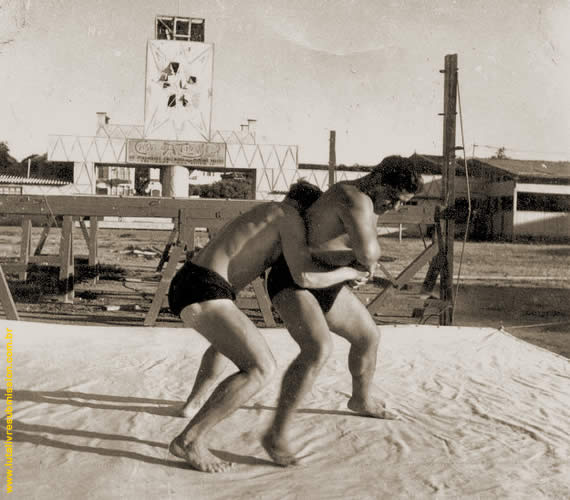


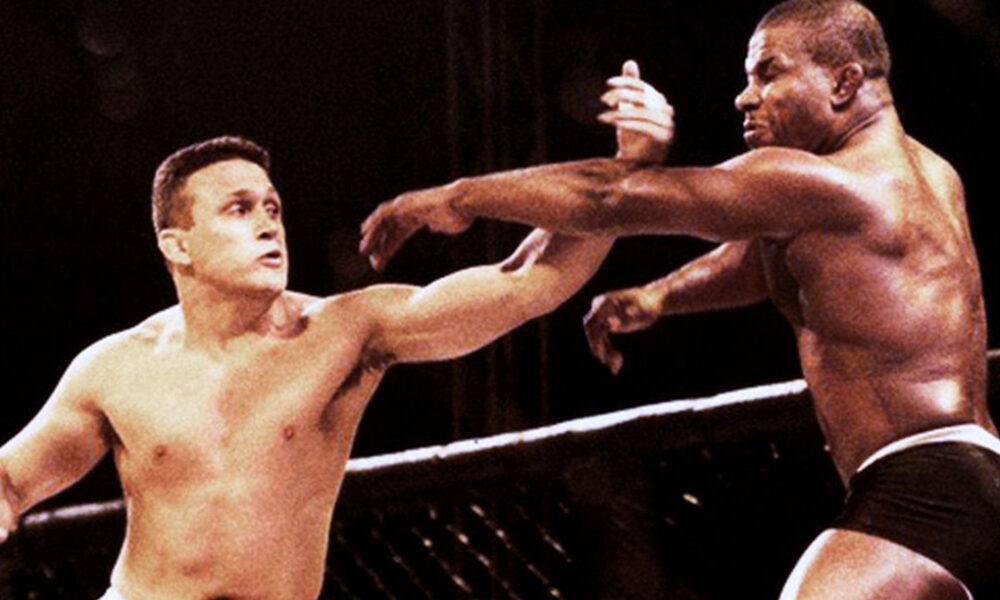
BJJ and Luta Livre are two Brazilian submission arts that look very similar, yet they come from different roots. Brazilian jiu-jitsu descends from judo and was traditionally practised in the gi, whereas Luta Livre comes from catch wrestling and is practised without a gi. Today, on the no-gi mat, the two resemble each other so much that many people see them as the same sport. And yet, behind that technical closeness lies one of the fiercest rivalries in martial arts history.
Table Of Content
On the mat, in the gi as well as no-gi, one question keeps coming up among practitioners: “What’s the actual difference between Luta Livre and BJJ?” We’ll answer it clearly. First the concrete differences, then the story of their war in Brazil, and finally which one to choose when you start.

What is Luta Livre?
Luta Livre is a Brazilian art of ground fighting and submission, practised without a gi. Its name literally means “free fighting” in Portuguese. It was born in Rio de Janeiro in the first half of the 20th century, out of catch wrestling (the Anglo-American grappling style), and not from judo like BJJ.
Its founding figure is Euclydes “Tatu” Hatem, who structured the discipline in Rio during the 1930s and 1940s. In 1942, Hatem famously beat George Gracie, laying the first stones of a rivalry that would last for decades. Because it is practised in a rashguard and shorts, Luta Livre has always emphasised control without fabric grips, which naturally brings it close to modern grappling.
What is Brazilian jiu-jitsu?
Brazilian jiu-jitsu (BJJ) is a ground-fighting art built on control, dominant positions and submissions, and it descends from judo. The Gracie family developed and popularised it from the 1920s onward, after Japanese judoka Mitsuyo Maeda brought his knowledge to Brazil. It was historically practised in the gi, even though no-gi has exploded over the last twenty years.
The great strength of BJJ is its positional system and its gi game, where grips on the fabric (collar, sleeves, lapels) open up a range of controls and chokes that don’t exist in no-gi. For the detail of positions and vocabulary, we cover it all in our guide to the basic techniques of BJJ and in our article on the meaning of each belt.
BJJ vs Luta Livre: what are the real differences?
The three real differences between BJJ and Luta Livre are origin, the gi and culture. Technically, on the ground, the two actually share the vast majority of their positions, sweeps and submissions. Here is the clear comparison.
| Criterion | Luta Livre | Brazilian jiu-jitsu |
|---|---|---|
| Origin | Catch wrestling | Judo |
| Attire | No gi (rashguard, shorts) | Gi originally, also no-gi |
| Historic founder | Euclydes “Tatu” Hatem | Gracie family (via Mitsuyo Maeda) |
| Fabric grips | No | Yes (in the gi) |
| Ranking system | Its own | White to black belt |
| On the mat today | Almost the same sport in no-gi | |
Origin: catch wrestling vs judo
Luta Livre comes from catch wrestling, BJJ comes from judo. That is the fundamental difference. Catch emphasises reversals, dynamic control and direct submissions, without ever using a jacket. Judo, on the other hand, gave BJJ its throwing culture and above all its entire gi game, a heritage we detail in our BJJ vs judo comparison. Two different roots, then, for a ground game that eventually converged.
The gi: gi vs no-gi
Luta Livre is practised without a gi, while BJJ is traditionally practised with one. That is the most visible difference for a beginner. In no-gi, there is no fabric to grab, so the game is faster, based on underhooks, wrist control and leg attacks. In the gi, by contrast, the game is slower and more strategic, because grips on the fabric slow the opponent down and open up specific chokes.
What we always tell beginners: the gi and no-gi are almost two different sports. If you are just starting out, don’t try to be good at both at once. Focus on one, build your foundations, and open up the other later. Trying to do everything at the same time is the surest way to progress twice as slowly.
Culture and history
The deepest difference between BJJ and Luta Livre is cultural and social. In Brazil, the two disciplines carried opposite identities: BJJ was long associated with wealthier circles, Luta Livre with working-class ones. That social divide fed a rivalry which went far beyond sport, eventually turning into open warfare for years.
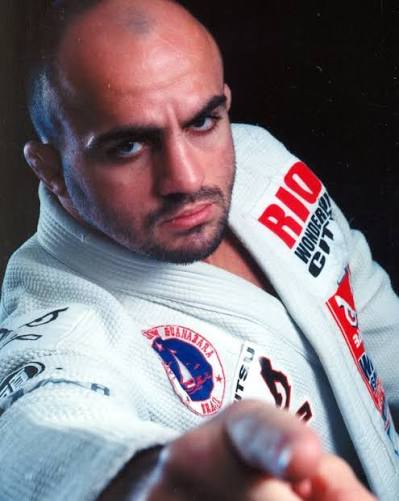
BJJ vs Luta Livre: where does their historic rivalry come from?
The rivalry between BJJ and Luta Livre is one of the most famous in martial arts history. During the 1980s and 1990s in Rio, the two schools clashed to prove which one was more effective, in the street as well as in organised challenges. Concretely, this war directly fuelled the rise of vale tudo, the ancestor of MMA.
Two disciplines, two Brazils
The rivalry was first of all a matter of social class. The Gracies’ BJJ grew in the wealthy districts of Rio, with an expensive gi that already signalled a social status. Luta Livre, on the other hand, took root in working-class neighbourhoods, accessible without the costly gi. Two worlds that did not mix, then, and a tension that was structural long before it became personal.
1988: Rickson Gracie vs Hugo Duarte on the beach
One of the founding episodes of the rivalry took place in 1988 on Pepê beach, in Rio. Rickson Gracie and Hugo Duarte, one of Luta Livre’s champions, faced off in the open air in front of witnesses. Rickson clearly got the upper hand. The exact circumstances remain disputed, however, with Hugo Duarte claiming he was hindered by the Gracie entourage during the exchange.
A few months later, Duarte struck back: he showed up at the Gracie Academy with a group of fighters to demand an immediate rematch. Rickson beat him again, and the brawl that followed forced the neighbours to call the police. That episode marks the real start of open warfare between the two camps.
1991: the Jiu-Jitsu vs Luta Livre Desafio
In 1991, the event “Desafio: Jiu-Jitsu vs Luta Livre”, fought under vale tudo rules (strikes allowed), officially brought the two camps together in Rio. The BJJ team, led notably by Wallid Ismail, Fabio Gurgel and Murilo Bustamante, dominated the encounter. In the most violent bout of the night, Wallid Ismail, then a brown belt, took Eugenio Tadeu down, opened a cut over his eyebrow and dominated him until Tadeu, exhausted, failed to return to the ring in time. The referee’s count gave BJJ the win, even though Tadeu always claimed he was prevented from coming back by members of the opposing camp.
For BJJ, it was a show of force. For Luta Livre, on the other hand, it was a humiliation that left a lasting resentment. That resentment would directly fuel the outbreak of violence in 1997, six years later.
1997: the Pentagon Combat riot
The peak of the rivalry came on 27 September 1997, at the Pentagon Combat in Rio, during the fight between Renzo Gracie and Eugenio Tadeu. The bout turned into a full-blown riot: Luta Livre supporters, who had got in in large numbers, climbed the cage, the gym lights went out, chairs flew, and an overwhelmed police officer eventually fired a shot in the dark. Organisers declared the fight a no contest, with no winner.
Consequences were heavy. The authorities banned MMA in Rio de Janeiro for three years. And here is the detail few people know: Sheikh Tahnoon bin Zayed was financing the event, and it was from the failure of Pentagon Combat that the idea of the ADCC was born, today the largest grappling competition in the world. That night of chaos therefore paradoxically gave rise to one of the pillars of the modern sport.
Rivalry on the MMA stage
Arrival of the UFC in 1993 gave the rivalry a new stage, this time filmed and broadcast worldwide. Royce Gracie won UFC 1, 2 and 4 by submitting opponents far heavier than himself, which propelled BJJ to the top of the martial arts world. As a result, in the collective imagination, it is Brazilian jiu-jitsu that now embodies Brazilian ground fighting.
But Luta Livre had its answer. Marco Ruas, who blended Luta Livre and muay thai, won UFC 7 in 1995 in impressive fashion, dominating his opponents standing and on the ground. His victory proved that Luta Livre also produces top-level fighters, capable of shining in the context of nascent MMA.
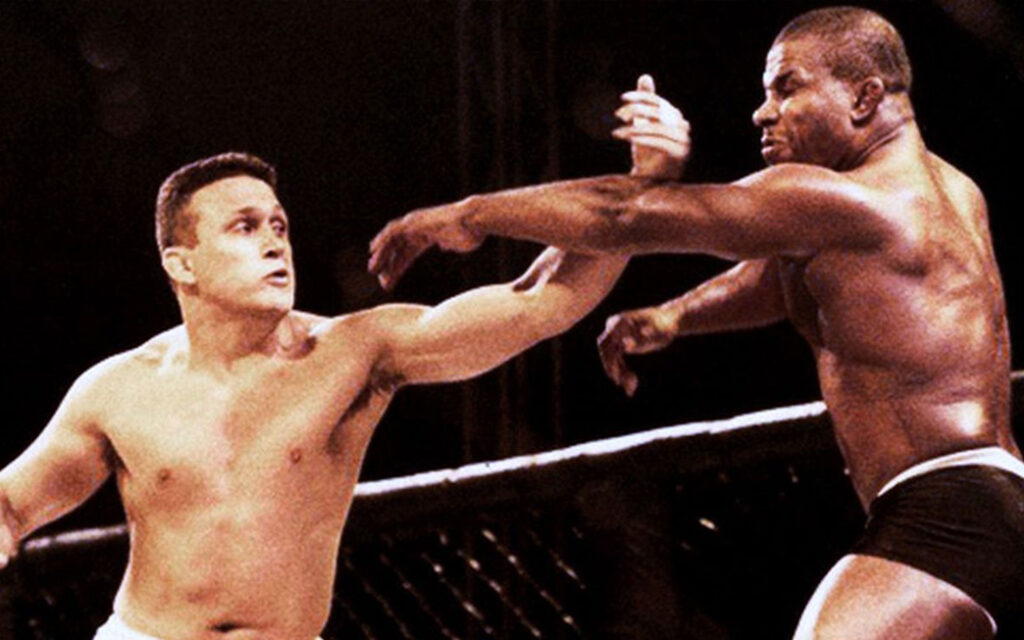
Why do BJJ and Luta Livre look so alike today?
Today, no-gi BJJ and Luta Livre have become almost inseparable technically. The sport has evolved so much that the best competitors take whatever works from everywhere, without caring about the label. A Luta Livre practitioner and a no-gi BJJ practitioner rolling together use the same guards, the same leg attacks, the same controls.
That is why the term “grappling” took over: this umbrella word covers all gripping ground fighting with submissions, without a gi. On the competition circuit (ADCC, major submission wrestling events), fighters come from BJJ, Luta Livre or wrestling alike, and meet on the same mat with the same arsenal. The distinction remains real in terms of history and pride of origin, but on the mat, it is the same work.
One point deserves honesty: BJJ owes part of its development to this rivalry. The constant pressure from Luta Livre forced jiu-jitsu practitioners to test their techniques in hostile conditions, to plug their gaps, and never to rest on their achievements. Without that competition, BJJ would probably have evolved more slowly. Martial arts rarely progress in comfort, but almost always in confrontation.
Luta Livre or BJJ: which should you choose as a beginner?
For a beginner, the best choice between Luta Livre and BJJ is not a question of discipline, but of gym. Pick the place closest to you, with a good coach and a good atmosphere, where you feel comfortable. Whether it is labelled Luta Livre, no-gi BJJ or grappling, you will learn the same fundamentals of ground fighting anyway. To get it right, read our guide on how to choose your first BJJ academy.
If you are torn between gi and no-gi, here is our recommendation. The gi is excellent for building solid foundations: the game is slower, you have time to think, and working with the fabric forces you to be precise. No-gi, by contrast, is more athletic and transfers better to MMA or self-defence. Many practitioners start in the gi for the basics, then add no-gi, but the reverse works very well too. And if you are truly starting from scratch, begin with our guide on starting BJJ. The important thing is to start.
To go further, we finally recommend our article on the history of Brazilian jiu-jitsu in 10 key dates, our profile of Rickson Gracie, a central figure in this rivalry, and the one on Marcelo Garcia, the absolute reference in no-gi.
FAQ: BJJ and Luta Livre
What is the difference between Luta Livre and BJJ?
Luta Livre comes from catch wrestling and is practised without a gi, whereas BJJ descends from judo and is traditionally practised in the gi. Technically, on the ground, the two are very close today, especially in no-gi.
Is Luta Livre the same as Brazilian jiu-jitsu?
No, they are two originally distinct disciplines that have converged. Luta Livre is a Brazilian art derived from catch wrestling, while BJJ comes from judo. In modern no-gi competition, the two are practised almost identically.
Why was there a rivalry between BJJ and Luta Livre?
The rivalry between BJJ and Luta Livre was both sporting and social. In Brazil, BJJ was associated with wealthier circles and Luta Livre with working-class ones. Both camps wanted to prove their style superior, which led to famous and sometimes violent challenges in the 1980s and 1990s.
What was the 1997 Pentagon Combat riot?
The 1997 Pentagon Combat was a vale tudo event in Rio whose main bout, Renzo Gracie vs Eugenio Tadeu, descended into a riot. Supporters invaded the ring, the lights went out and shots rang out in the dark. The incident led to a three-year ban on MMA in Rio and inspired the creation of the ADCC.
Is Luta Livre practised with a gi?
No, Luta Livre is practised without a gi, in a rashguard and shorts. This is one of its historic differences with traditional Brazilian jiu-jitsu, which is practised in the gi.
Should you choose Luta Livre or BJJ to start?
Above all, choose a good gym close to you, with a good coach and a good atmosphere. Whether it is Luta Livre, no-gi BJJ or grappling, you will learn the same fundamentals of ground fighting. The label matters less than the quality of the teaching.
Does Luta Livre still exist today?
Yes, Luta Livre still exists and is still taught, notably in Brazil and Europe. Modern grappling and no-gi BJJ have nonetheless absorbed much of its practice, to the point where the technical border has become very thin.