 EN
EN FR
FR PT
PT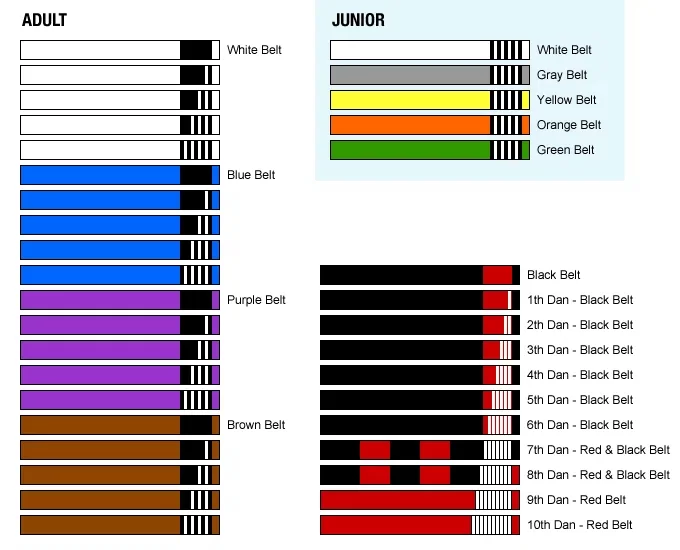
Five adult belts, eight to twelve years to black, and a single judge: your coach. BJJ belts cannot be bought and are not earned through exams. This guide lays out the order of the ranks, the minimum times and ages set by the IBJJF, and what is expected of you at each stage, from white to red.
The BJJ belt system is one of the slowest and most demanding in martial arts. There are only five adult ranks (white, blue, purple, brown, black), and each one can take years. Unlike judo or karate, Brazilian jiu-jitsu belts are not handed out for attendance or through a standardized test: they are awarded when the practitioner is ready, technically, physically and mentally. And the coach decides, and only the coach. There is no official checklist. Every promotion is an act of trust between a coach and a student, and that is exactly what makes the system respected worldwide.
If you are just starting and want the big picture before stepping on the mats, begin with our complete guide to your first BJJ class. If you already know the system, test yourself with the belts and ranks quiz after reading.
In this article11
- The Order of BJJ Belts, in Short
- BJJ Belts for Kids
- The White Belt: Where It All Begins
- The Blue Belt: Building the Foundations
- The Purple Belt: Defining Your Game
- The Brown Belt: The Antechamber of Black
- The Black Belt: The Start of a New Journey
- The Belts Above Black
- How Long Does Each BJJ Belt Take?
- BJJ Belts: Frequently Asked Questions
- Our Take at BJJ-Rules
The Order of BJJ Belts, in Short
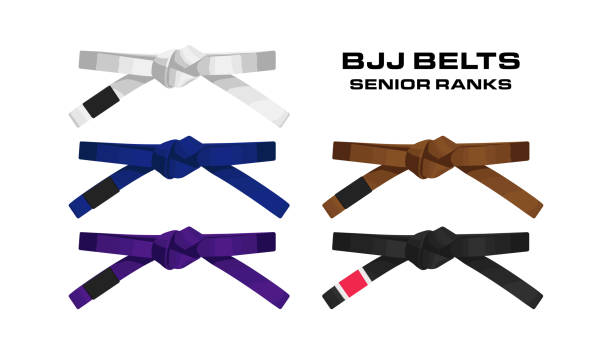
For adults, the order is always the same: white, blue, purple, brown, black. After black come the degrees and, decades later, the coral, red-and-white and red belts. The times below are the official IBJJF minimums (the federation that runs the Worlds) and the real-world averages seen in academies at two to three sessions a week.
| Belt | Minimum age (IBJJF) | Minimum time at rank (IBJJF) | Real average time |
|---|---|---|---|
| White | None | None | 1 to 2 years |
| Blue | 16 | 2 years | 2 to 3 years |
| Purple | 16 | 1.5 years | 1.5 to 3 years |
| Brown | 18 | 1 year | 1 to 2 years |
| Black | 19 | 3 years per degree (1st to 3rd) | 8 to 12 years in total |
A detail many people miss: the IBJJF minimums only apply to those who want to compete in its events with a registered rank. Inside the academy, the coach is free, and most go well beyond these minimums.
BJJ Belts for Kids
Before the adults, a word on children. From age 4, kids can train BJJ with an adapted ranking system defined by the IBJJF. The path runs from white to green, with each color split into three sub-levels (for example grey-white, grey, grey-black) and stripes in between to mark progress.
White belt is the starting point, where the basics and discipline are learned. The grey belt (ages 4 to 15) is the first real promotion. The yellow belt (7 to 15) shows a growing command of the fundamentals. Orange belt (10 to 15) marks a more defined style. The green belt (13 to 15) is the last kids’ rank and prepares the transition to the adult path: at 16, the young athlete moves straight to blue, or back to white if the coach deems it necessary. Progress does not depend on time alone: attendance, attitude and the ability to apply techniques count just as much.
The White Belt: Where It All Begins
Everyone starts here. The white belt is jiu-jitsu’s baptism by fire, and probably the hardest phase. Not technically, since nobody expects much from you at this stage, but mentally. You will get submitted. A lot. By everyone. And that is completely normal.
What is expected of a white belt
The goal is not to master everything. It is to survive and learn how to learn. Concretely, you are expected to know the fundamental positions: closed guard, half guard, mount, side control and back control. You will learn your first defenses, the principles of control and a few simple submissions. But what matters most is the mindset: a good white belt is someone who comes back, who accepts tapping without getting discouraged, who watches, asks and improves step by step. In BJJ, persistence beats raw talent.
Average time: 1 to 2 years before promotion to blue, training 2 to 3 times a week. The IBJJF sets no minimum time, only the age of 16 to receive the blue belt.

The Blue Belt: Building the Foundations
The blue belt is a relief. You survived the baptism. You start to understand what is happening on the mat, you get your first submissions, you escape bad positions and you begin to handle the white belts. It is an exciting time.
The “blue belt blues” trap
But it is also the rank with the highest dropout rate, the famous “blue belt blues”. The novelty has worn off, progress slows down, purples and browns are still far above you and the road to black looks endless. Those who get through this phase are usually the ones who find motivation beyond the rank: the pleasure of rolling, competing, teaching, or simply the routine. This is the level where you start building a personal game: the guards you like, the submissions that work, the chains that become your weapons.
If you are a blue belt going through a rough patch, read our article on how to improve training only twice a week. Sometimes the problem is not the level, it is the rhythm.
Average time: 2 to 3 years at blue before promotion to purple. IBJJF minimum: 2 years.

The Purple Belt: Defining Your Game
The purple belt marks a real turning point. You are no longer a beginner. You are recognized in the academy as someone who knows what they are doing. The game becomes more fluid and instinctive, and the chains come naturally.
A recognizable game
Most purple belts have a recognizable game: a favorite guard (De La Riva, half guard, butterfly), a preferred strategy (pressure passing or bottom game) and signature moves that training partners spot within seconds of the round starting. This is the phase where you build your identity as a grappler. It is also when many start teaching: helping beginners, explaining a technique, correcting a position. Teaching is often the best way to truly understand what you do.
The purple belt is also a test of patience. Progress becomes less visible, you can plateau for months, and improvement is measured in details, not revelations. It is refinement work.
Average time: 1.5 to 3 years at purple. IBJJF minimum: 1.5 years.

The Brown Belt: The Antechamber of Black
Brown belt is the phase of details. The big technical discoveries are behind you; what changes is the precision, timing and efficiency of every move. You know what you are doing, and now you learn to do it better.
Refining every move
At this level you learn to save energy: instead of strength, you look for the right timing. Every movement gets cleaner, the game becomes subtle and intelligent, and mistakes become rare. You become a reference for the lower ranks, who watch how you move and learn from it. It is also a period of mental consolidation: a calm, strategic mind able to analyze training with perspective. In competition, brown belts often face black belts in the absolute, a valuable reality check. If you can hang with the best, the next rank is not far.
Average time: 1 to 2 years at brown before promotion to black. IBJJF minimum: 1 year, and age 19 to receive the black belt.

The Black Belt: The Start of a New Journey
Contrary to what many think, the black belt is not the end. It is the beginning of a new chapter. The practitioner is recognized for technique, experience and the ability to pass on knowledge. They are no longer just a student: they become an ambassador of the art.
What the black belt really represents
It takes, on average, 8 to 12 years of consistent training to earn this rank in BJJ, significantly longer than in most other martial arts. That is exactly why it carries so much weight: when someone wears a jiu-jitsu black belt, you know that person has been through years of work, doubt and questioning.
Black belt degrees
The black belt is divided into degrees that reflect seniority and continued commitment, on a schedule set by the IBJJF: from 1st to 3rd degree, a new degree every 3 years; from 4th to 6th, every 5 years. A 6th degree therefore has at least 24 years as a black belt. A first degree is a recent black belt; a fifth or sixth degree is a master with decades of practice. It is often said that you only start to truly understand jiu-jitsu from this rank on.
To see what that means at the highest level, explore the careers of Buchecha (13 world titles), Roger Gracie (simplicity turned into art) or Marcelo Garcia (the master of the butterfly guard). Each embodies a different facet of what the black belt can become.

The Belts Above Black
Beyond black, BJJ recognizes seniority, contribution to the art and the transmission of values. These ranks do not reward performance: they honor a life devoted to jiu-jitsu.
The coral belt (7th degree)
This red-and-black belt is awarded at the 7th degree, seven years after the 6th. Adding up the IBJJF schedule, it represents at least 31 years of practice after earning the black belt.
The red-and-white belt (8th degree)
Rarer still: awarded to masters who reach the 8th degree, seven years after the 7th, so at least 38 years as a black belt. Whoever wears it has devoted most of their life to jiu-jitsu, as a teacher and an ambassador.

The red belt (9th and 10th degree)
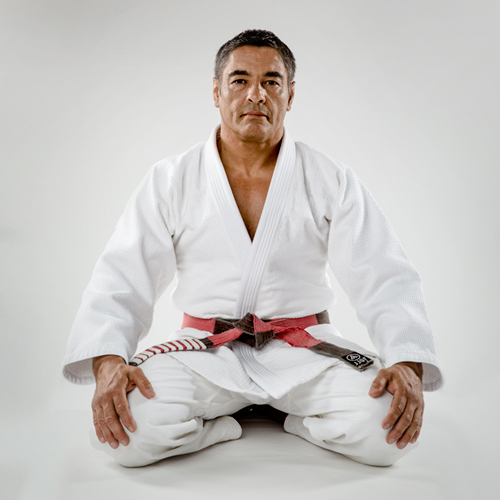
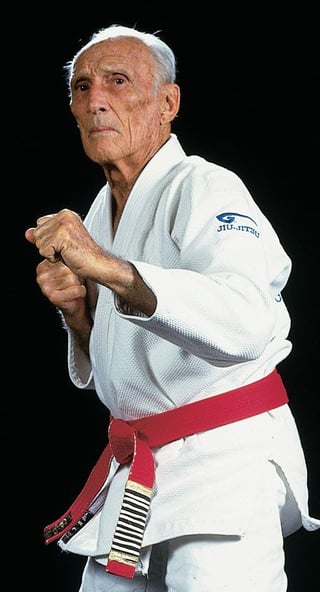
The red belt is the highest distinction among all BJJ belts. 9th degree comes ten years after the 8th, so after at least 48 years as a black belt, and is reserved for exceptional masters. The 10th degree is strictly reserved for the pioneers, the Gracie brothers who founded the art: no other practitioner can reach it today. Rickson Gracie, long a coral belt, has worn the red belt since 2017.
How Long Does Each BJJ Belt Take?
This is the question everyone asks. Here are the average timelines, at 2 to 3 sessions a week. These numbers vary with the academy, the coach, training frequency and competition involvement.
| Promotion | Average time | Cumulative time |
|---|---|---|
| White → Blue | 1 to 2 years | 1 to 2 years |
| Blue → Purple | 2 to 3 years | 3 to 5 years |
| Purple → Brown | 1.5 to 3 years | 5 to 8 years |
| Brown → Black | 1 to 2 years | 8 to 12 years |
Three remarks. First, these are averages: some elite competitors earn the black belt in 5 or 6 years (the Ruotolo brothers, for instance), and many recreational practitioners take 15 years or more, with no shame in that. Second, there is no right pace: BJJ is a marathon, not a sprint, and what matters is consistency and quality of practice. Third, the IBJJF minimums (2 years at blue, 1.5 at purple, 1 at brown) are a floor, not a target: most coaches go well beyond them.
BJJ Belts: Frequently Asked Questions
What is the order of BJJ belts?
For adults: white, blue, purple, brown, black. After black come the degrees (1st to 6th), the coral belt (7th degree), the red-and-white belt (8th degree) and the red belt (9th and 10th degree). For kids aged 4 to 15: white, grey, yellow, orange, green.
How long does it take to get a BJJ black belt?
On average, 8 to 12 years of consistent training. The IBJJF minimums add up to 4.5 years from blue (2 at blue, 1.5 at purple, 1 at brown), and the minimum age for black is 19. Elite competitors get there in 5 or 6 years; recreational practitioners may take 15 years or more.
Can you skip a belt?
In theory, no: the IBJJF system requires sequential progression. In practice, a few high-level athletes coming from wrestling or judo may receive blue or purple quickly if their technical level justifies it. It is rare and always at the coach’s discretion.
Who decides on belt promotions?
Your coach. There is no official exam in BJJ, no kata to demonstrate, no panel of judges. The coach watches your progress over months and years and decides when you are ready. It is a system built on trust, which is why choosing your academy matters so much.
Are stripes mandatory?
No. Stripes indicate progress between two belts, but not every academy uses them. Some give four stripes before each promotion; others give none and award the belt directly when the time comes. Both approaches are equally valid.
Do BJJ belts count in no-gi?
Yes. Your rank stays the same whatever the format. In no-gi competition you compete in your belt division; the only difference is that the belt is not physically worn in training or in matches.
Our Take at BJJ-Rules
Let’s be direct: the belt matters. Pretending otherwise would be hypocritical. When you receive the blue after two years of struggle, when you see purple coming after years of work, when one day your coach ties the black belt around your waist, those moments are powerful and deserve to be celebrated.
But the belt does not tell the whole story. It does not say whether you are a good training partner, whether you help beginners, whether you keep learning with humility. The best practitioners we know are not necessarily the highest ranked: they are the ones who make the mat better by being on it. So yes, chase the next rank and work for it. But don’t forget that the real rank is what you do between promotions. And if you need a reminder of why you started, reread our article on Marcelo Garcia: it puts everything in perspective.
Read next
Quiz: BJJ belts and ranks · Starting BJJ: your first class · How to improve training twice a week · BJJ glossary · Roger Gracie: when simplicity becomes art
Learn from the best: our recommended instructionals
The videos we actually recommend, hand-picked from the BJJ Fanatics catalog.

Georges St-Pierre
Mixed Martial Arts Fundamentals
MMA fundamentals from GSP: distance, takedowns, control. To understand jiu-jitsu when strikes are involved.
View on BJJ Fanatics →
John Danaher
Go Further Faster Bundle
The complete gi fundamentals in 8 volumes: guard retention, pin escapes, passing. The foundation, from the most influential coach of the era.
View on BJJ Fanatics →
Lachlan Giles
The Half Guard Anthology
Half guard from A to Z by the clearest teacher in no-gi. Ideal for smaller grapplers.
View on BJJ Fanatics →Disclosure: affiliate links. The price is the same for you and your purchase supports BJJ-Rules.