 EN
EN FR
FR PT
PT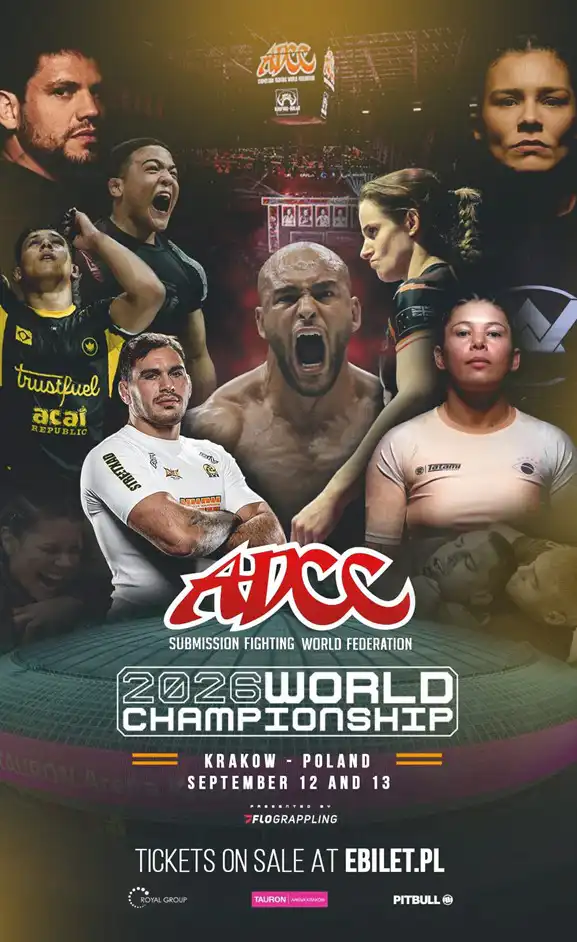
Two historic firsts, five Brazilian golds, a whole family on the mats, Gordon Ryan in the stands and a Tauron Arena on fire for the Polish title: here are the ADCC 2026 results, with the nine champions crowned in Krakow on September 12-13, and the stories behind the weekend.
The ADCC 2026 results will be remembered as a changing of the guard. The first ADCC World Championship held in Europe since 2017 crowned nine champions, seven of them for the first time, and wrote two brand-new lines in the tournament’s history: Felipe Pena became the first athlete to win the absolute twice, and Helena Crevar, at 19, the youngest women’s champion the ADCC has ever had. On the starting line, only three of the nine 2024 champions were defending a crown: the FloGrappling commentators had said it from the opening bell, the tournament was wide open. It stayed that way to the end, inside a Krakow arena that shook like never before for its own champion, Pawel Jaworski. Division by division, then behind the scenes, here is what happened.
In this article9
- The complete ADCC 2026 honor roll
- Felipe Pena, the man who won the absolute twice
- Helena Crevar, champion at 19, and Ana Carolina Vieira’s repeat
- The men’s divisions: four nations, five new champions
- Behind the scenes of day 1
- Superfight, the numbers and the lessons
- FAQ: the ADCC 2026 results in brief
- What comes next?
- Also read
The complete ADCC 2026 honor roll
| Division | Champion | Finalist | Verdict |
|---|---|---|---|
| -66 kg | Kennedy Maciel (Brazil) | Gavin Corbe | Decision after 28 minutes |
| -77 kg | Magomed Dzharbaev (Russia) | PJ Barch | Referee decision |
| -88 kg | Pawel Jaworski (Poland) | Marlon Tajik | Decision, 0-0 on the scoreboard |
| -99 kg | Luke Griffith (South Africa) | Kaynan Duarte | Submission |
| +99 kg | Victor Hugo (Brazil) | Josh Saunders | Submission |
| Women -55 kg | Jasmine Rocha (Brazil) | Ana Rodrigues | Submission |
| Women -65 kg | Ana Carolina Vieira (Brazil) | Sarah Galvão | Rear naked choke, double overtime |
| Women +65 kg | Helena Crevar (USA) | Anabel Lopez | Submission |
| Absolute | Felipe Pena (Brazil) | Roosevelt Sousa | Rear naked choke (10:03) |
| Superfight | Yuri Simoes (Brazil) | Kaynan Duarte | Submission (22:26) |
The two lines marked in red are the ones that make history: a second absolute for Pena, and a superfight that cost Kaynan Duarte dearly, already beaten in the -99 kg final a few hours earlier.
| Nation | Titles | Champions |
|---|---|---|
| Brazil | 5 | Maciel, Victor Hugo, Rocha, Vieira, Pena |
| United States | 1 | Helena Crevar |
| Russia | 1 | Magomed Dzharbaev |
| Poland | 1 | Pawel Jaworski |
| South Africa | 1 | Luke Griffith |
By continent, all medals included, South America counted nine, Europe eight (including two golds, its best haul in tournament history), North America six, Oceania two and Africa two. For the first time, Europe is breathing down the neck of Brazil and its neighbors.
Felipe Pena, the man who won the absolute twice
From Saturday, Pena had set the tone: two rounds, two submissions, including a quarterfinal run to 9-0 and closed with a rear naked choke, with a three-point guard pass the commentators called the turning point. Then Josh Saunders stopped him in the +99 kg semifinal, and the Belo Horizonte veteran seemed to be leaving the tournament through the back door.
On Sunday, he answered history. A points win over Eoghan O’Flanagan, submissions over Francis Pana and Ruslan Abdulaev, and a final closed with a rear naked choke on Roosevelt Sousa at 10:03. In fifteen editions, nobody had ever won the open weight twice.
The performance says everything about what the ADCC absolute is: a tournament within the tournament, fought on accumulated fatigue, where size matters less than energy management and a sense of occasion. Pena, who had already beaten Gordon Ryan in the 2017 absolute, closes a loop none of his direct rivals, starting with Ryan himself, ever managed to close. Ryan, as it happens, was in Krakow, but seated matside next to John Danaher: the cameras showed him from the quarterfinals on, a spectator of a tournament he dominated for eight years.
Helena Crevar, champion at 19, and Ana Carolina Vieira’s repeat
Top seed at +65 kg, the American Helena Crevar submitted every opponent up to Anabel Lopez in the final, becoming at 19 the youngest women’s champion in ADCC history. From Saturday, the arena applauded each of her walkouts, and her ankle attacks from the guard set the tone. Four years after Kade Ruotolo’s precocity record on the men’s side, the generation raised on the mats since childhood now has its women’s face.
The two other women’s titles stayed Brazilian. Jasmine Rocha submitted Ana Rodrigues at -55 kg, and Ana Carolina Vieira, 32, a five-time IBJJF world champion, kept her -65 kg crown by choking out 20-year-old Sarah Galvão with a rear naked choke in double overtime. Vieira becomes the first woman to win back-to-back titles since Gabi Garcia in 2017 and 2019.
Two names from that -65 kg final tell the ADCC as a family affair: Sarah Galvão is the daughter of André Galvão, long the king of the superfight, and Jasmine Rocha is the sister of Achilles and daughter of Wagner Rocha. On Saturday, all three Rochas won their opening round, in front of a crowd discovering that a whole lineage could hold a bracket.
The men’s divisions: four nations, five new champions
At -66 kg, 13th seed Kennedy Maciel first survived a guillotine from Fabricio Andre in the quarters, toppled top seed Diego Pato in the semifinal, then wore down Gavin Corbe in a 28-minute marathon final. Son of Rubens “Cobrinha” Charles, champion of the same division in 2013, 2015 and 2017, he signs the first ADCC title passed from father to son. At -77 kg, Russia’s Magomed Dzharbaev, a daily training partner of Islam Makhachev, first shut down Poland’s Adam Szczecinski with an overtime takedown, then took the referees’ decision over PJ Barch.
The loudest moment of the weekend will remain the -88 kg final: Pawel Jaworski, carried by the whole Tauron Arena, beat Sweden’s Marlon Tajik on decision after a tense 0-0, the only Polish gold of the edition. Poland fielded eight athletes in front of their home crowd, and the commentators had called it “a breakout year for the European grapplers”: Jaworski was the proof, Szczecinski the promise.
At -99 kg, the upset came from South Africa’s Luke Griffith, the 2024 +99 kg runner-up, who dropped a division. His quarterfinal against Stefan Bont sums up the ADCC: no points after regulation, a passivity penalty each, and an overtime takedown to advance. In the final, he submitted 2024 double champion Kaynan Duarte. At +99 kg, Victor Hugo, imperious in the quarters, submitted Josh Saunders, Pena’s conqueror the day before and a 5-0 winner over Roosevelt Sousa in the quarters. Roberto “Cyborg” Abreu, at the ADCC since 2009, was stopped in the quarters by Achilles Rocha, a kid who has known him his whole life “like an uncle”, and who beat him on the strength of his scrambles.
Behind the scenes of day 1
Saturday’s broadcast delivered the stories the honor roll does not tell. Opening round was a submission festival: on a single mat, six of the eight opening bouts ended before the limit, to the point that the commentators described a tournament “like no other: it doesn’t matter what you accomplished anywhere else, here you have to do it again”. The Olympics of submission, in their words.
The arena also saw Joslyn Molina, a teenage invitee and the youngest competitor in tournament history, entered at -55 kg against far bigger opponents, and whose aggression dragged matches all the way to decisions. Maiza Bastos earned her first-ever qualification for day 2 after a ground war with Valerie Hamilton. And the Polish crowd, “incredibly excited” according to the broadcast, turned the Tauron Arena into a hall that rumbled from the first bout to the last.
Also worth noting, the day before, the ADCC amateur world championship, an open tournament held in the same arena: hundreds of anonymous grapplers fought on the champions’ mats, a format the ADCC intends to grow to anchor the event in each host city.
Superfight, the numbers and the lessons
The superfight between Kaynan Duarte and Yuri Simoes went to the latter, by submission at 22:26, in an overtime where Duarte appeared to injure his shoulder. The weekend of the Brazilian, double champion in 2024, therefore ends with two final defeats, a brutal reminder of what a two-year cycle costs at this level.
Of the 103 matches outside the absolute, 50 ended by submission, 48.5%, with chokes from the back on top (19), ahead of straight ankle locks and triangles (6 each). The technical reading is clear: despite a few titles snatched from the guard, ADCC 2026 confirmed that standing wrestling and back attacks remain the keys at the highest level. The scoreless overtimes, passivity penalties and decisive takedowns seen all weekend are the signature of a unique ruleset.
For the full reading grid, from scoring to overtimes, our ADCC 2026 guide remains current.
FAQ: the ADCC 2026 results in brief
Who won the ADCC 2026 absolute?
Felipe Pena won the ADCC 2026 absolute by submitting Roosevelt Sousa with a rear naked choke in the final. He becomes the first athlete in tournament history to win the absolute division twice.
Who is the youngest women’s champion in ADCC history?
Helena Crevar, +65 kg champion in Krakow in 2026 at age 19, became the youngest women’s champion in ADCC history after submitting every one of her opponents.
Who won the ADCC 2026 superfight?
Yuri Simoes beat Kaynan Duarte by submission at 22:26, in overtime, in the ADCC 2026 superfight in Krakow.
Which country won the most titles at ADCC 2026?
Brazil, with five of the nine titles: Kennedy Maciel, Victor Hugo, Jasmine Rocha, Ana Carolina Vieira and Felipe Pena. The United States, Russia, Poland and South Africa won one title each.
Did Gordon Ryan compete at ADCC 2026?
No. Gordon Ryan was not entered in Krakow, but he attended the tournament matside alongside John Danaher, as the broadcast showed from day one.
What comes next?
The next ADCC World Championship will take place in 2028, the tournament remaining biennial. Until then, the trials will reshuffle the deck, Crevar will be 21, Molina will have grown up and Pena will have a place in history to defend. To check that you followed Krakow closely, our ADCC champions quiz awaits, and for everything else, head to the BJJ-Rules quiz page.
Also read
Learn from the best: our recommended instructionals
The videos we actually recommend, hand-picked from the BJJ Fanatics catalog.
John Danaher
The Front Headlock System
Guillotine, anaconda, darce: the full front headlock system, from control to finish.
View on BJJ Fanatics →
Craig Jones
Power Ride: A New Philosophy on Pinning
Wrestling-style riding adapted to no-gi. Craig Jones, serious for once.
View on BJJ Fanatics →
Craig Jones
The Triangle Machine
The triangle from every position, with the adjustments that make it work against bigger opponents.
View on BJJ Fanatics →Disclosure: affiliate links. The price is the same for you and your purchase supports BJJ-Rules.