

How to Wash a BJJ Gi: The Complete Guide
Let’s start with a truth nobody disputes in the world of Brazilian jiu-jitsu: if your gi stinks, you are a problem. Not an unpleasant training partner, no, a real problem. Indeed, nobody wants...

Let’s start with a truth nobody disputes in the world of Brazilian jiu-jitsu: if your gi stinks, you are a problem. Not an unpleasant training partner, no, a real problem. Indeed, nobody wants to roll with someone whose gi smells like an abandoned locker room, and your coach should not have to tell you. Learning to wash your BJJ gi properly is the absolute baseline of mat etiquette. Yet a surprising number of practitioners get it wrong.
Table Of Content
- Why is washing your BJJ gi as important as your training?
- How to wash your BJJ gi step by step
- What common problems come up when you wash your BJJ gi?
- Should you wash your belt and no-gi gear like your BJJ gi?
- How to wash your BJJ gi day to day without the hassle?
- What are the essential rules for washing your BJJ gi?
- FAQ: washing your BJJ gi
- What should you remember about washing your BJJ gi?
We are not talking about practitioners who never wash their gi (hopefully that species is going extinct). We mean those who do wash it, but shrink it after three months, cannot get rid of ingrained odors, watch their white gi turn yellow, or destroy the seams through bad machine settings. So if you are starting Brazilian jiu-jitsu, this guide will save you the classic mistakes. And if you have trained for years, you will probably find tips you did not know.
Why is washing your BJJ gi as important as your training?
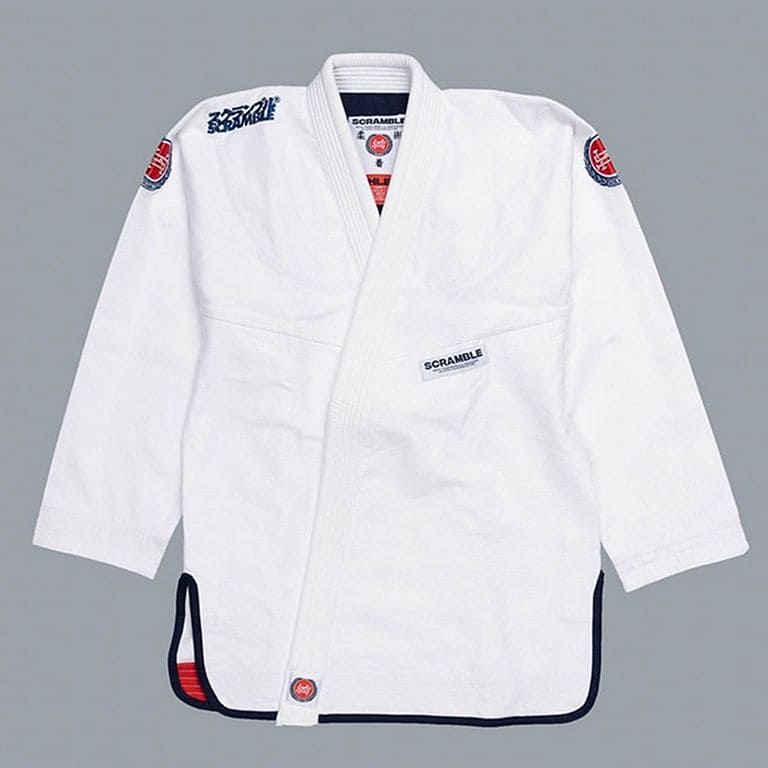
Washing your BJJ gi properly matters for three concrete reasons: hygiene, respect for your partners and the lifespan of your gear. Indeed, a poorly maintained gi builds up bacteria and fungi, gives off stubborn odors and wears out early. Concretely, careful maintenance protects your health, the mats and your budget.
Because it is not just about comfort. A poorly maintained gi creates three concrete problems every practitioner should take seriously.
Hygiene: bacteria, fungi and skin infections
Your gi is an ideal playground for micro-organisms. During a BJJ session, you sweat heavily, you are in skin-to-skin contact with your partners, and your gi absorbs everything: sweat, dead skin cells, saliva, sometimes blood. Cotton, the main material of most gis, holds moisture like a sponge. So without a quick wash, bacteria multiply within hours. That is how the common skin infections you see on the mats appear: staph, impetigo, ringworm and other fungal issues. And some of these infections are contagious and can spread through a whole gym if a single practitioner neglects their hygiene.
Respect for your partners
In any BJJ academy in the world, there is an unwritten rule: you do not roll with a dirty gi. It is above all a matter of basic respect. Indeed, your partner will spend several minutes with their face pressed against your collar, your sleeves, your chest. As a result, if your gi gives off an odor, even a faint one, it is a silent aggression that people do not always dare to mention. Experienced coaches know it well: a gi that smells is often a gi that dried in a gym bag before being washed the next day, or even two days later.
The lifespan of your gear
A good BJJ gi costs between $80 and $200. That is not a trivial investment, especially when you know a regular practitioner needs at least two gis in rotation. Concretely, proper care can make a gi last 3 to 5 years. On the other hand, poor care (too high a temperature, the dryer, harsh products) can ruin it in a few months: shrinkage, seams giving way, thinning fabric and fading colors.
How to wash your BJJ gi step by step
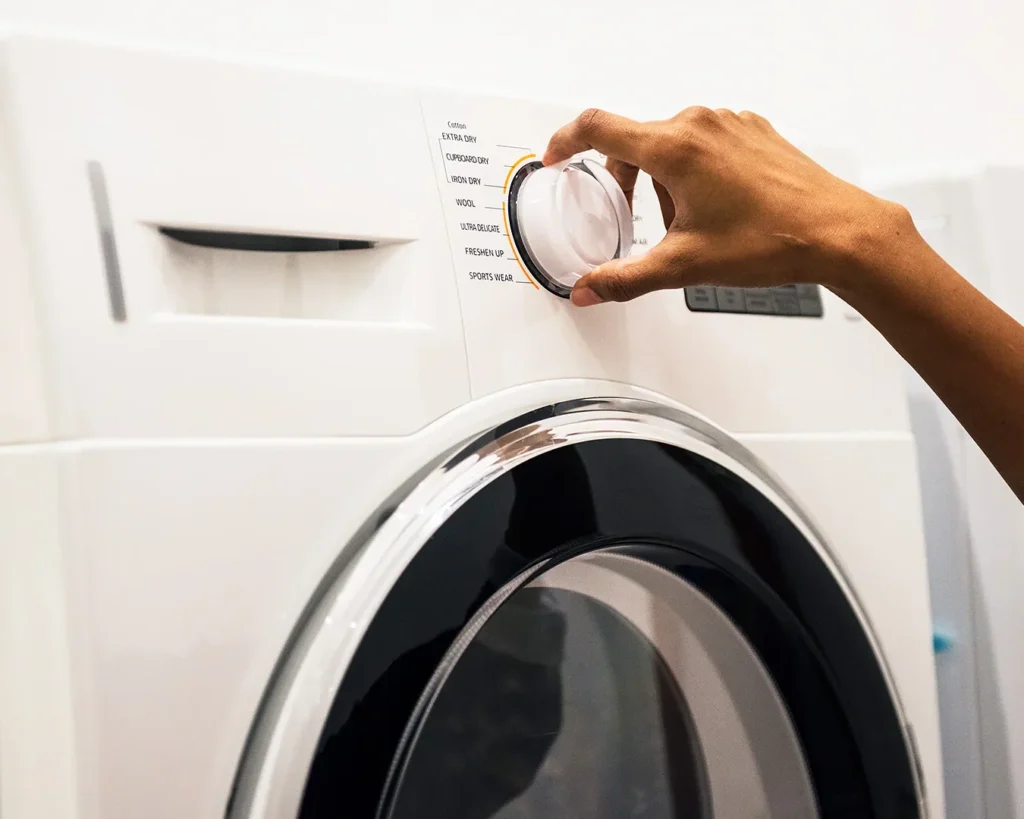
To wash your BJJ gi properly, take it out of the bag as soon as you get home, turn it inside out, then wash it at 30°C (86°F) maximum with a mild detergent, no bleach and no fabric softener. Then air dry it on a hanger, never in the dryer. This way, you protect the fibers and effectively prevent shrinkage.
Here is the full method, from stepping off the mats to putting the gi back in the bag. Every step counts, and most mistakes happen in the first minutes after training.
Step 1: Take the gi out of the bag right away
This is rule number one, and the most often ignored. As soon as you get home after training, take your gi out of the bag and hang it up. Never let it soak in its own juices at the bottom of a closed bag: that is the best way to create a bacteria farm and an odor that becomes impossible to remove later. Moreover, if you cannot wash it right away, at least spread the jacket and pants on two separate hangers so they start air drying. This simple habit makes a huge difference.
Step 2: Turn the gi inside out
Before putting your gi in the machine, turn the jacket and pants inside out. This protects the embroidery, the patches and the outer surface of the fabric from drum abrasion. It is a habit that takes 30 seconds and, this way, preserves the look of your gi for years.
Step 3: Set the machine to 30°C (86°F) maximum
This is where most practitioners go wrong. The ideal temperature to wash your BJJ gi is 30°C (86°F), no more. At 40°C (104°F), the shrinkage risk rises significantly, especially for 100% cotton gis. And at 60°C (140°F), it is almost guaranteed: your gi will lose half a size, or even a full size, irreversibly.
Why is shrinkage such a problem? In IBJJF competition, your gi must meet precise measurements. Since late 2024, the sleeves must stop no more than 2 cm from the wrist (down from 5 cm before), and the pants no more than 2 cm above the ankle. So a gi that has shrunk can cost you a failed inspection, or even disqualification, before you even step on the mats. Day to day, moreover, a gi that is too tight limits your movement and gives your opponents easier grips.
Use a delicate or normal cycle, without an intensive spin, which weakens the seams and warps the fabric. Indeed, a spin at 800 RPM maximum is plenty.
Step 4: Detergent, simple and mild
Use a standard liquid detergent, ideally without harsh whitening agents. The amount recommended by the maker is enough: no need to double it thinking it will clean better. On the contrary, excess detergent leaves residue in the fibers that attracts bacteria and can cause skin irritation.
What to avoid at all costs: bleach. Indeed, it weakens cotton fibers, yellows the fabric over time, and can trigger skin reactions in your partners. Fabric softeners are also discouraged: they leave a film on the fibers that reduces absorption and can create a favorable environment for bacteria.
Step 5: Drying, patience required
Absolute rule: never the dryer. Never. The dryer is indeed the number one enemy of your gi. The heat causes accelerated shrinkage and weakens the fibers with each cycle. Moreover, even a low-temperature program stays risky for a cotton gi.
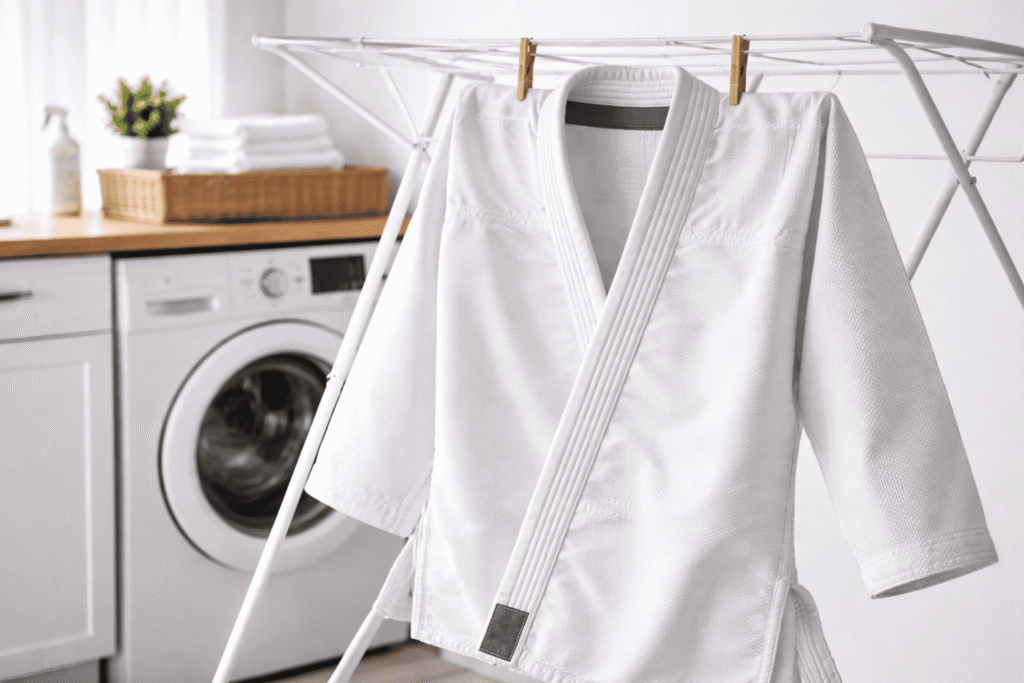
The correct method: hang your gi on a sturdy hanger, in the open air or in a ventilated room. Separate the jacket and pants for even drying. Then, gently pull on the sleeves and pant legs while the gi is still damp: this helps prevent shrinkage by stretching the fibers back into their natural position. Finally, avoid prolonged direct sun, because UV rays fade colored gis and yellow white gis over time.
What common problems come up when you wash your BJJ gi?
The most frequent problems when you wash your BJJ gi are ingrained odors, blood stains, yellowing of white fabric and shrinkage. Fortunately, each has a simple fix: white vinegar for odors, cold water for blood, sodium percarbonate against yellowing, and strict prevention against shrinkage.
Even by following every best practice, some problems eventually show up. Here are the most common ones and the solutions that actually work.
Ingrained odors
If your gi still smells after a normal wash, the problem probably comes from a buildup of bacteria in the fibers, often caused by sessions where the gi sat too long before being washed. The fix: soak your gi in a basin of cold water with 200 ml (about 1 cup) of white vinegar for 30 to 60 minutes before the machine wash. Indeed, white vinegar is a natural antibacterial that neutralizes odors without damaging the fabric. It is by far the most effective and least aggressive method.
Alternative: baking soda. Add 2 to 3 tablespoons directly into the drum, on top of your usual detergent. It absorbs odors and helps clean deeply. Moreover, you can combine both methods for the toughest cases.
Blood stains
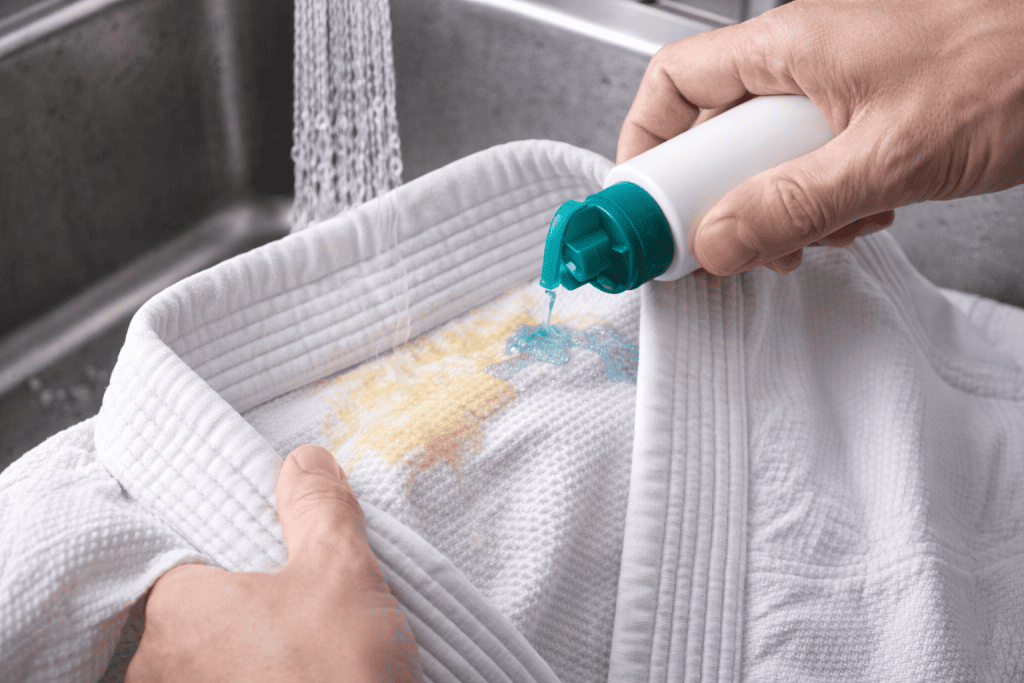
Blood is common in BJJ: split lips, scratches, poorly trimmed nails. On a white gi, an untreated blood stain can become permanent. So the key is to treat the stain before the machine wash. Rinse it immediately in cold water (never hot water, because heat sets the blood proteins into the fibers). Then rub gently with a mild bar soap (like Marseille soap) or sodium percarbonate, let it work for 15 minutes, then machine wash normally.
Yellowing of the white gi
A white gi that yellows over time is normal, but it can be fought. Yellowing is caused by the buildup of sweat, sebum and detergent residue in the fibers. To fix it, do a monthly soak in sodium percarbonate (oxygen bleach): 2 tablespoons in a basin of lukewarm water, soak for 2 to 4 hours, then wash normally. It is far more effective and less aggressive than bleach.
Shrinkage
If your gi has already shrunk, the options are limited. Slight shrinkage can sometimes be eased by wearing the gi damp after washing, because the fibers stretch a little with movement. On the other hand, for significant shrinkage there is no miracle: it is largely irreversible. So prevention stays the best strategy: 30°C (86°F), no dryer, and pulling on the sleeves and legs during drying.
Tip for new gis: the first two or three washes are when shrinkage is most pronounced. Some brands (Shoyoroll, Tatami, Kingz) offer pre-shrunk gis, which limit this. So if your gi is not pre-shrunk, expect a 3 to 5% reduction, a factor to consider when you choose your gear.
Should you wash your belt and no-gi gear like your BJJ gi?
Yes, you should wash your belt and no-gi gear exactly like your BJJ gi. The belt indeed soaks up the same sweat and the same bacteria: the myth of the belt you never wash has no hygienic basis. Rashguards and shorts also wash at 30°C (86°F), with mandatory air drying.
Washing your BJJ belt
There is a stubborn myth in the BJJ world: “you never wash your belt.” Some claim that washing your belt brings bad luck or symbolically erases the experience you built up. It is poetic, but it is also completely unhygienic. Indeed, your belt touches the same mats as your gi, soaks up the same sweat, and gathers the same bacteria. So wash your belt, ideally every time you wash your gi, or at least once a week if you train regularly.
To protect it, wash it in a laundry net so the ends do not fray in the drum. Use the same temperature as the gi: 30°C (86°F), air drying. Moreover, if you worry about colors fading, know that quality belts (Kataaro, Scramble) hold up very well to repeated washes. To better understand what each belt represents, read our article on the meaning of BJJ belts.
Caring for your rashguard and no-gi shorts
Rashguards and grappling shorts are simpler to care for than gis, but still deserve attention. They are usually polyester or a synthetic blend, materials that dry fast but hold odors if they are not washed quickly. So the same reflex applies: out of the bag immediately and washed as soon as possible at 30°C (86°F). No dryer either, because heat warps the elastane and the prints crack.
How to wash your BJJ gi day to day without the hassle?
To wash your BJJ gi day to day without stress, the key stays organization: own at least two gis in rotation, hang the gi as soon as you get home, then run the machine the next morning. This way, you always have a clean, dry gi, even when drying takes time in winter.
The theory is fine, but in practice, washing your gi after every session when you train 3 to 5 times a week takes a bit of organization.
How many gis should you own?
The absolute minimum is two gis in rotation. With a single gi, you have to wash and dry it between each session: doable if you train twice a week, but impossible beyond that. Three gis is the ideal comfort: you always have a clean, dry gi available, even if the weather slows drying. Finally, for practitioners who train daily, four gis are not a luxury. Even with two sessions a week, having a spare gi avoids the last-minute drying stress.
The ideal routine
Here is what works for most regular practitioners. When you get home from training, take out your gi and hang it on a hanger. The next morning, turn it inside out and put it in the machine at 30°C (86°F) with your belt and rashguard. After the cycle, hang the gi immediately to dry: never leave it in the machine more than an hour, or the odors come back. In summer, a gi dries in 4 to 6 hours in the open air. In winter, on the other hand, count 12 to 24 hours in a heated room, which is why having several gis in rotation helps.
Portable solutions when traveling
If you travel for a camp or a competition, bring a waterproof bag dedicated to the dirty gi. This way, you avoid contaminating the rest of your things. Moreover, antibacterial sports sprays (Dettol Sport, Defense Soap) can tide you over between washes, but they never replace a real machine wash. Finally, for longer stays, hand washing in the bathtub with liquid detergent stays a perfectly viable option.
What are the essential rules for washing your BJJ gi?
The essential rules for washing your BJJ gi come down to a few reflexes: wash after every session, out of the bag immediately, turn it inside out, 30°C (86°F) maximum, mild detergent with no bleach or softener, then air drying. Finally, white vinegar against odors and sodium percarbonate against yellowing round out the routine.
🥋 The quick reference: washing your BJJ gi
- Frequency: after every session, no exceptions
- Temperature: 30°C / 86°F max (never 60°C / 140°F)
- Spin: 800 RPM max, gentle cycle
- Detergent: mild, no bleach or softener
- Drying: air dry on a hanger, never the dryer
- Stubborn odors: soak in 200 ml (1 cup) white vinegar, 30 to 60 min
- Yellowing: sodium percarbonate, monthly soak 2 to 4 h
- Rotation: 2 gis minimum, 3 for comfort
In short, never letting a damp gi sit in a bag stays the rule that protects all the others. The myth of the belt you never wash, meanwhile, is just an excuse for neglect: wash it like the gi.
FAQ: washing your BJJ gi
Do you really need to wash your BJJ gi after every training session?
Yes, without exception. During a Brazilian jiu-jitsu session, your gi soaks up a large amount of sweat, bacteria and dead skin cells, both yours and your partners’. A gi worn for two sessions without washing becomes a bacteria nest that can cause skin infections and will inevitably smell bad, even if you no longer notice it yourself (your nose adapts to its own odors).
Can you wash a BJJ gi at 40°C (104°F)?
It is not recommended for regular use. At 40°C (104°F), the risk of shrinkage is real, especially for pure cotton gis. An occasional 40°C wash can be justified to clear an infection or particularly stubborn odors, but no more than once a month. For everyday washing, stick to 30°C (86°F).
How do you get rid of a gi smell that stays after washing?
Soak the gi in a basin of cold water with 200 ml (about 1 cup) of white vinegar for one hour before machine washing. If that is not enough, try a baking soda soak (3 tablespoons). As a last resort, an occasional 40°C cycle with sodium percarbonate should beat the most resistant odors. Above all, find the cause: if you regularly leave your gi in the bag for hours before washing it, that is the root of the problem.
My gi shrank: can I get it back?
Slight shrinkage can sometimes be eased by wearing the gi damp and moving around a little: the fibers stretch under tension. However, significant shrinkage is largely irreversible. Prevention stays the best approach: 30°C (86°F) every time and air drying only.
Should you wash a new gi before wearing it?
Yes, it is recommended. A first wash at 30°C (86°F) removes manufacturing residue (chemicals, starch) and stabilizes the fibers. It is also when the initial shrinkage happens, and it is better for that to occur before your first class than after. A new gi can shrink 3 to 5% over the first washes, a factor to keep in mind when you buy.
Can you use bleach on a white gi?
No. Bleach weakens cotton fibers and eventually turns the fabric yellow, which is exactly the opposite of what you want. Use sodium percarbonate instead, which whitens effectively without attacking the fibers. It is the solution used by experienced practitioners and recommended by most gi manufacturers.
Will a properly washed gi pass competition inspection?
Yes, and care contributes directly. Since late 2024, the IBJJF allows a maximum of 2 cm between the sleeve and the wrist, down from 5 cm before, so an overly shrunk gi fails inspection. The rules also require a clean, dry, odor-free gi. Washing your BJJ gi properly, without shrinking it, stays the best way to see it approved.
What should you remember about washing your BJJ gi?
In short, washing your BJJ gi properly comes down to simple gestures: 30°C (86°F), no dryer, white vinegar for odors and never a damp gi forgotten in a bag. Beyond technique, a clean gi stays the first mark of respect toward your partners, your coach and the discipline itself.
A clean gi is indeed the first mark of respect in Brazilian jiu-jitsu. Before your technique, before your belt rank, before your record, it is the hygiene of your gear that tells your partners and your coach that you take this discipline seriously. And washing your BJJ gi properly is nothing complicated: 30°C (86°F), no dryer, white vinegar for odors, and above all, never let a damp gi marinate in a bag. It is that simple.
Take care of your gi, and it will take care of you. Indeed, every roll on the mats with a clean, well-kept gi is silent proof that you respect the sport, your partners, and the tradition of this century-old discipline.
Follow all the BJJ news on BJJ-Rules, the number one Brazilian jiu-jitsu media in France.