
BJJ for Women: The Complete Beginner’s Guide
Brazilian jiu-jitsu is still a male-dominated sport today. Yet the number of women practising BJJ is exploding all over the world, and in France too. The reasons are many: effective self-defense,...

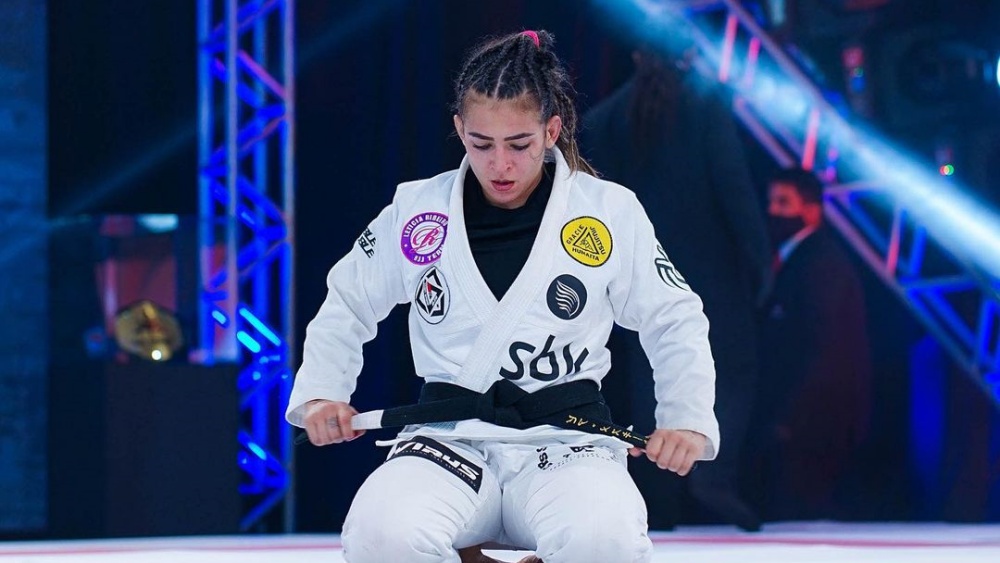
Brazilian jiu-jitsu is still a male-dominated sport today. Yet the number of women practising BJJ is exploding all over the world, and in France too. The reasons are many: effective self-defense, self-confidence, complete physical conditioning, a tight-knit community. But for a woman who is just starting out, stepping onto the mat can feel intimidating. This guide is for you.
Table Of Content
- Why is BJJ for women such a great idea?
- What are the most common fears for women starting BJJ?
- How do you choose a BJJ academy as a woman beginner?
- What gear and clothing do you need for BJJ for women beginners?
- How do you progress in BJJ as a woman beginner?
- What does BJJ for women look like in competition?
- Conclusion: BJJ for women, a decision you won’t regret
- FAQ: BJJ for women beginners
We answer here every question a woman beginner asks herself before her first class. Do you need to be athletic to start? How does physical contact with male partners work? What should you wear? How do you progress? Here, therefore, is everything you need to know about BJJ for women, without apprehension and with the right tools.
⚡ Key takeaways
| ✅ Why start | Self-defense, self-confidence, complete sport, strong community |
| 🥋 Level required | None. Physical conditioning is built on the mat |
| 💰 Starting budget | €60 to €100 for a gi, ~€10 for a mouthguard |
| 📅 Ideal frequency | 2 sessions per week, consistently, rather than bursts |
| 💡 Key to success | Technique and leverage rather than brute strength |
Why is BJJ for women such a great idea?
BJJ for women is a great idea because the discipline relies on leverage and technique, not on brute strength. Concretely, a practitioner can therefore control a heavier partner through positioning and timing. In this way, Brazilian jiu-jitsu offers self-defense, self-confidence and complete physical conditioning, with no athletic prerequisite.
Brazilian jiu-jitsu is not a sport of brute force. It is a discipline built on leverage, technique and strategy. That is precisely why BJJ suits women particularly well. A good technician, male or female, can therefore control a bigger and heavier opponent through an advantageous position and a precise application of biomechanical principles.
Concretely, this means a woman beginner does not need to be physically imposing to progress quickly. Technique beats strength. It is one of the great promises of BJJ for women, and it is one that holds true.
BJJ for women: a self-confidence that changes everything
One of the effects most often cited by women who practise BJJ is the boost in self-confidence. Knowing that you are able to handle a ground-fighting situation, to control an opponent or to escape an uncomfortable position deeply changes your relationship to your body and to space. That is no small thing.
Many practitioners also report a heightened sense of safety in their daily life, well beyond the mat. This is often the main reason that pushes a woman beginner to sign up for a Brazilian jiu-jitsu class.
A complete sport, physically and mentally
Physically, BJJ is extraordinarily complete. It develops functional strength, flexibility, cardiovascular endurance, proprioception and coordination. One hour of sparring burns as many calories as an intense CrossFit session. And it is far more fun.
Mentally, BJJ is often described as chess in motion. It demands total presence, pressure management and the ability to solve problems in real time. These skills transfer directly to professional and personal life. It is therefore far more than a simple combat sport.
What are the most common fears for women starting BJJ?
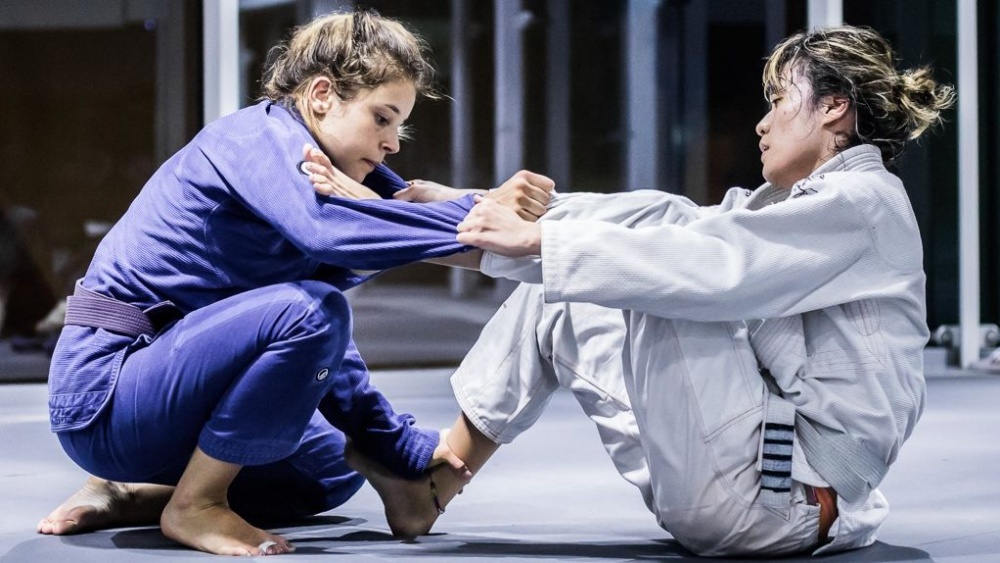
The fears of women beginners in BJJ revolve mainly around four points: training with men, not being athletic enough, close physical contact and the risk of injury. Yet these apprehensions are almost always overcome within the first few weeks. Here are direct and honest answers to each of them.
“Will I have to fight against men?”
This is question number one. The answer is nuanced. In most academies, especially in France where mixed classes are the norm, you will train with male partners. This is particularly true at the start, if you are the only woman in the class.
In practice, it generally goes very well. BJJ has a deeply rooted culture of respect for the training partner. A serious male partner therefore adapts his intensity. He is not trying to crush a beginner. He is trying to improve too, which goes through clean drilling and constructive sparring. Of course, as in any sport, there are exceptions. If a partner is disrespectful, speak to your coach directly.
“I’m not athletic, it’s too hard for me”
This fear is extremely common. Yet it is unfounded. BJJ for women beginners is precisely one of the rare combat sports where you can progress quickly without any prior athletic background. Physical conditioning is built on the mat. You do not need to be fit to start. You will be fit because you started.
The first classes are often exhausting. That is perfectly normal. The body discovers unusual movements and uncomfortable positions. But after a few weeks, endurance increases, the movements become smoother and the effort feels less intense. This is how progress begins.
“Physical contact makes me uncomfortable”
This is a legitimate concern. BJJ is a close-contact sport. It involves close grips you will not find in any other team sport. For many women beginners, this aspect is indeed the hardest to get used to at first.
The good news is that you adapt over time. As you progress, contact becomes technical. It is contextualised, supervised, athletic. The vast majority of practitioners report that after a few weeks, this aspect is no longer an issue. The mat is, in effect, a safe space with its own codes, and the BJJ community takes care of that.
“I’m going to get injured”
As in any contact sport, the risk of injury exists in BJJ. But it is often overestimated by beginners. In reality, BJJ is statistically less traumatic than football, rugby or even skiing. The culture of the “tap”, meaning you submit before the lock starts to hurt, is fundamental and respected in serious academies.
To minimise the risk, choose an academy with serious supervision, communicate your limits to your coach and partners, and report any unusual pain immediately. Tap early and without hesitation during sparring: that is how you avoid the vast majority of avoidable injuries.
How do you choose a BJJ academy as a woman beginner?
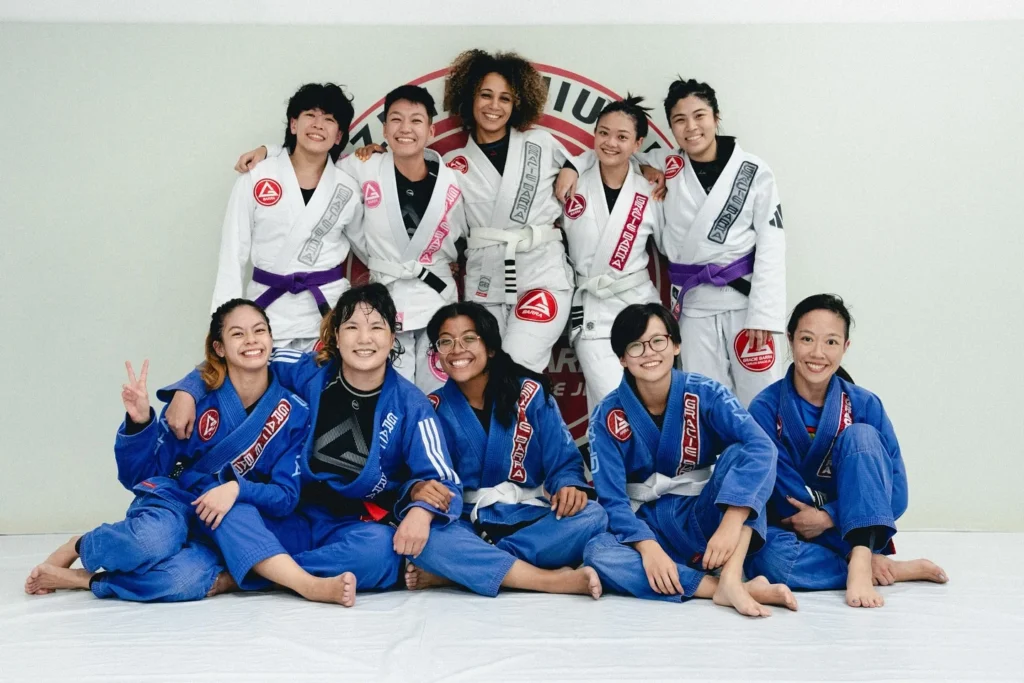
To choose a BJJ academy as a woman beginner, prioritise three criteria: the presence of beginner or women’s classes, a coach attentive to the atmosphere, and ideally other female practitioners on the mat. In this way, your first experience has every chance of being positive rather than discouraging.
Classes dedicated to women or to beginners
Some academies offer classes specifically dedicated to women, or strictly supervised beginner-level classes. That is a real plus for a first experience. These classes notably allow you to progress in a more homogeneous environment, at a suitable pace. If your local academy does not offer women’s classes, it is not a deal-breaker. Simply ask the question during your first visit.
A coach attentive to the overall atmosphere
The atmosphere of an academy is felt from the very first visit. Do the partners encourage each other? Does the coach correct with kindness? And finally, are beginners respected? These indicators apply to everyone, but they matter particularly when it comes to BJJ for women beginners. So do not hesitate to watch a class as an observer before signing up.
The presence of other women on the mat
The presence of other female practitioners is a good sign. It shows that the academy is welcoming to women and that the atmosphere allows it. It is not, however, an absolute condition. Some excellent academies have few women simply due to a lack of local visibility. But if you have a choice between several clubs, favour the one where you will not be the only woman on the mat.
To find the best academies in France, read our article on how to start Brazilian jiu-jitsu and our guide to choosing your first BJJ academy.
What gear and clothing do you need for BJJ for women beginners?
For BJJ for women beginners, the basic gear consists of a gi (€60 to €100), a high-support sports bra and a mouthguard (under €10). In no-gi, plan instead for a rashguard and shorts or spats. Moreover, most clubs lend a gi for the first class.
The gi (kimono): the traditional Brazilian jiu-jitsu uniform
The gi is the traditional uniform of Brazilian jiu-jitsu. It consists of a thick jacket, trousers and a coloured belt that indicates your level. For gi BJJ classes, it is essential. Brands now offer gis specifically cut for female body shapes. Tatami Fightwear, Fuji, Venum and Scramble notably have good options in this range.
For your first gi, there is no need to invest in a high-end model. An entry-level gi around €60 to €100 is more than enough to start. Favour white or blue, the most widely accepted colours in all academies.
No-gi: an option appreciated by women in BJJ
Many academies also offer no-gi classes, where you train without the kimono. In that case, the standard outfit consists of a rashguard (a tight technical shirt) and shorts or spats (leggings). It is an option appreciated by many women beginners in BJJ, because the outfit is closer to usual sportswear. Contact is also often perceived as less intense without the gi fabric to grip.
Protective gear and specific underwear
Under the gi or the rashguard, a high-support sports bra is essential. Many practitioners also wear a rashguard under the gi for added comfort and coverage. A mouthguard is moreover strongly recommended as soon as you begin sparring. It is easily bought at a pharmacy or sports shop for under €10. Knee pads, for their part, can be useful if you have a history of knee issues or pain.
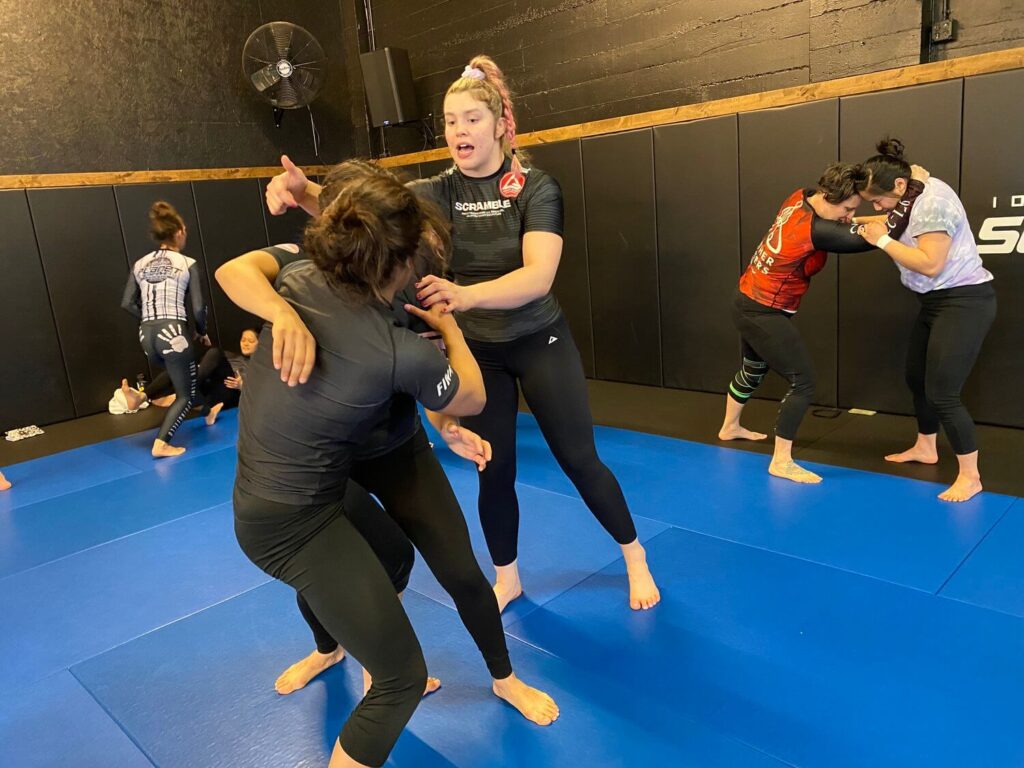
🥋 Checklist before your first class
| 👕 Minimalist outfit | Leggings or shorts, high-support bra, close-fitting shirt. No need to buy a gi before the first class, most clubs lend one |
| ✂️ Hygiene | Short nails (hands and feet), no perfume, no heavy make-up |
| 💍 Jewellery | Remove everything: rings, earrings, necklaces, visible piercings, watch. Hair tied back |
| ⏰ Arrival | 10 to 15 minutes early to meet the coach and introduce yourself |
| 💬 What to tell the coach | “It’s my first class” is enough. Also mention any injury or medical condition |
| 🧠 Mindset | Curiosity, not performance. No one judges a beginner, everyone has been there |
How do you progress in BJJ as a woman beginner?
To progress in BJJ as a woman beginner, consistency matters more than anything else. Concretely, two sessions per week on a steady basis are worth more than bursts of training. Moreover, it is better to rely on flexibility, footwork and timing than on brute strength.
Consistency above all
In BJJ, progress is directly tied to consistency. Two sessions per week on a steady basis are worth infinitely more than five sessions over two weeks followed by a month off. The body and brain indeed need repetition to absorb movements. There is no shortcut. Our article on how to improve in BJJ training twice a week will give you concrete ways to make the most of each session.
Making the most of flexibility and footwork
Women often have greater natural flexibility than men. In BJJ, this is a considerable asset, notably for the guard game. The closed guard, half guard, spider guard or De La Riva are positions where flexibility truly makes a difference. Many practitioners thus develop a very offensive leg game, which lets them off-balance physically much stronger partners.
On the other hand, a woman beginner in BJJ should not try to compete on strength with her male partners. That would be counterproductive and exhausting. The goal is to use technique, timing and leverage, not raw power. That is precisely why BJJ for women is so well suited.
Communicating with your coach and partners
Communication is fundamental, especially at the start. If a position makes you uncomfortable, say so. If a partner is too intense, speak to your coach. And finally, if you do not understand a movement, ask without hesitation. BJJ is indeed a sport where learning is collective. Good practitioners are always ready to help beginners, and good coaches create an environment where communication is natural and welcome.
What does BJJ for women look like in competition?
BJJ for women in competition is a rapidly expanding scene, in France as internationally. Indeed, the IBJJF offers women’s divisions at every level, from local events to the Worlds. Now, with UFC BJJ, women are also represented at the highest level of world grappling.
Athletes such as Aurélie Le Vern, the first French UFC BJJ champion, or Bia Mesquita, a legend of international women’s BJJ, show what Brazilian jiu-jitsu can offer as a path to a woman who fully commits to the discipline.
But if there is one name every woman beginner in BJJ in France should know, it is Laurence Cousin Fouillat. An absolute pioneer, world champion and academy founder, she embodies everything the discipline can offer a life.
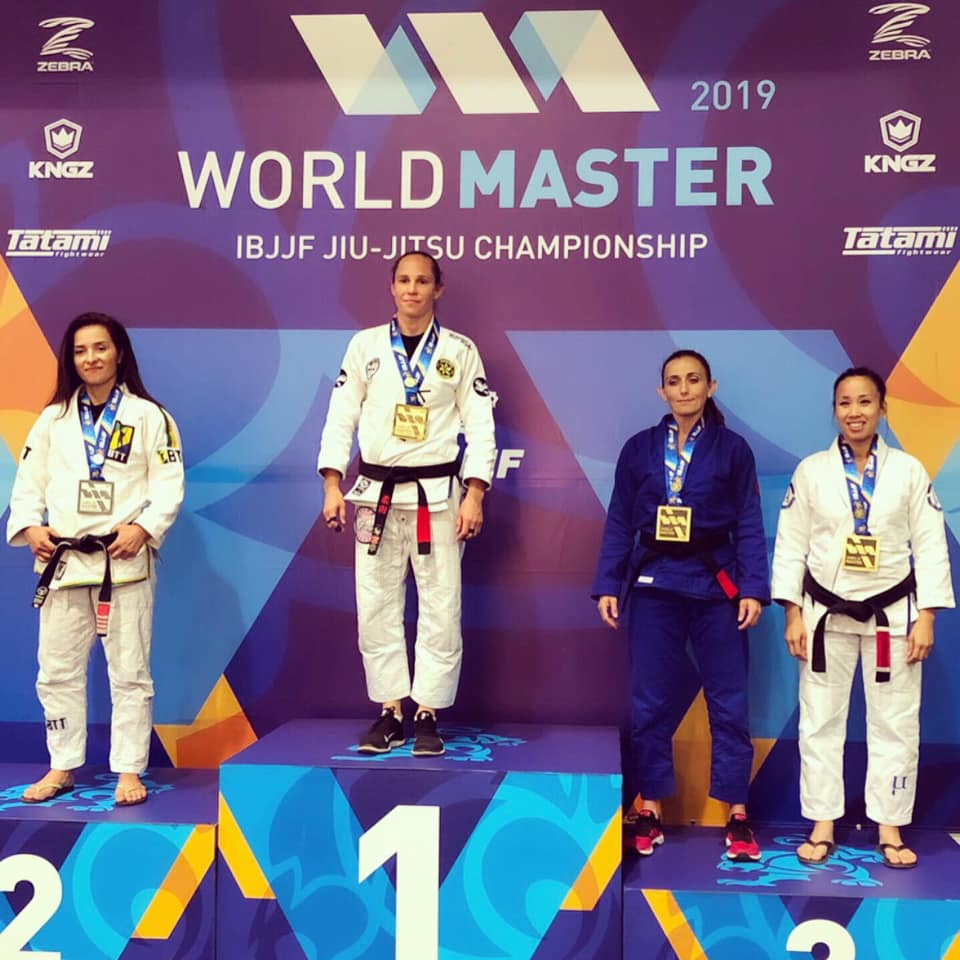
🏆 The French legend of women’s BJJ: Laurence Cousin Fouillat
Before you assume the very top level is reserved for Brazilians or Americans, you need to know Laurence Cousin Fouillat. Born on 7 August 1981 in Saint-Germain-en-Laye, this Frenchwoman is quite simply the pioneer of European women’s BJJ. She holds today the largest French competition record in the discipline, and is part of the “Female Dirty Dozen“, the first twelve non-Brazilian women to earn a BJJ black belt in the history of the sport.
| 🥋 Lineage | Maeda → Carlos Gracie → Helio Gracie → Flavio Behring → Cousin |
| 🎖️ Rank | 4th degree black belt (Behring lineage, Ribeiro Jiu-Jitsu team) |
| 👑 Historic firsts | 1st European woman BJJ black belt (2005), 1st European woman IBJJF World Champion at black belt (2007), 2nd non-Brazilian black belt to win Worlds gold (after Rafael Lovato Jr.) |
| 🏆 Major titles | IBJJF World Champion 2007, CBJJO World Cup 2005, double FILA World Champion gi and no-gi (2008-2009), six-time European Champion, team gold at the 2022 Worlds, IBJJF Masters World Champion (2025) |
| 🏠 Today | Head coach and founder of the Acemat academy (Toulouse, 2012), affiliated with the Ribeiro Jiu-Jitsu Association of brothers Saulo and Xande Ribeiro |
The takeaway: a Frenchwoman has already been a black-belt world champion, and more than twenty years after her debut she still steps onto international podiums. You might be the next. The ceiling no longer exists, it was shattered in 2007, in the IBJJF Worlds final.
Competition, however, is not an obligation. Many practitioners do BJJ their whole lives without ever stepping onto a competition mat, and they reap just as many benefits. That, too, is the beauty of this sport: it adapts to every goal.
Conclusion: BJJ for women, a decision you won’t regret
Getting started with BJJ for women beginners takes a bit of courage. The first classes are often intense and destabilising, and the ego takes hits, for everyone without exception. But after a few weeks, something changes. The body adapts. The movements become more natural. Confidence grows. And you no longer want to stop.
Brazilian jiu-jitsu is one of the rare sports where a woman can, through technique, control someone much bigger and stronger than her. It is a lesson in applied physics. But it is also a lesson in life. So find an academy near you, put on a gi, and step onto the mat. You won’t regret it.
FAQ: BJJ for women beginners
How much does a BJJ class cost in France?
An annual membership at a BJJ academy in France generally costs between €400 and €800 for unlimited access, depending on the region and the club’s reputation. Many academies offer a free trial class, or a discounted rate for the first month. To this, add the cost of the gi (€60 to €100 for an entry-level model) and a mouthguard (under €10). It is a reasonable investment compared to other sports such as horse riding or skiing.
At what age can a woman start BJJ?
There is no ideal age to start BJJ. Some women begin at 18, others at 45 or even 60, and all can progress at their own pace. Because the discipline is built on technique rather than athletic explosiveness, it stays accessible well past the age at which other combat sports become too demanding. The only prerequisite is the absence of a major medical contraindication. If in doubt, consult your doctor before starting.
Are there women-only BJJ classes in France?
Yes, more and more academies offer slots dedicated to women, particularly in large cities (Paris, Lyon, Marseille, Bordeaux, Toulouse). These classes are an excellent gateway for women beginners who prefer a homogeneous environment for their first months. Ask the clubs in your region directly, or check the Instagram pages of local academies to see whether they advertise women’s sessions.
Do you need to be flexible to start BJJ?
No, it is absolutely not necessary to be flexible to start BJJ. Flexibility is an asset, but it develops with practice. The first weeks on the mat use unusual ranges of motion, and the body gradually adapts. After a few months of regular practice, most practitioners notice a marked improvement in their general flexibility, without having followed any specific stretching programme.
How long does it take to get a blue belt in BJJ?
The blue belt is the first significant step in BJJ, and it is generally earned after 1.5 to 3 years of regular practice. The timeline depends on training frequency, the academy and the practitioner’s level. As a rough guide, with two sessions per week, count around two years on average. To understand the meaning of each rank, read our guide on what each Brazilian jiu-jitsu belt means.
Can you keep training BJJ during pregnancy?
The question of pregnancy in BJJ is above all medical, and the answer depends on each individual situation. Many experienced practitioners continue adapted training during the first trimester, avoiding intense sparring. Beyond that, most stop sparring to keep only light drilling or mobility work. The decision must absolutely be made with your gynaecologist or midwife, who knows your file. No article can replace personalised medical advice on this topic.
Is BJJ effective for women’s self-defense?
Yes, BJJ is particularly well suited to women’s self-defense, because it relies on leverage and technique rather than brute strength. A trained woman can thus neutralise a heavier attacker through control positions and precise submissions. However, BJJ does not cover every scenario, such as multiple attackers or the presence of weapons. It remains a major asset, ideally complemented by stand-up work.
⚠️ Disclaimer. This article is written for informational purposes and reflects the author’s experience as well as public sources. It in no way replaces professional medical advice. If you have any doubt related to your health (pregnancy, injury, specific condition), always consult a healthcare professional before starting or continuing BJJ practice.
To go further, read our complete guide to starting Brazilian jiu-jitsu, our article on how to choose your first BJJ academy, and our guide on improving in BJJ training twice a week. For official resources on women’s competitions in France, see the CFJJB website.