 EN
EN FR
FR PT
PT
Some athletes impose their dominance through raw power, others through relentless aggression that gives their opponents no room to breathe. And then there are those, like Bia Mesquita, who make everything look effortless — every movement arriving naturally, almost invisibly, as if jiu-jitsu had always belonged to them.
Bia Mesquita belongs to that rare category.
Watching her Brazilian Jiu-Jitsu matches, you immediately feel that everything about her execution is “clean”. There are no forced movements, no visible tension on her face, no panic in difficult moments. Instead, you see the right decisions landing at the right time, with a quiet confidence that contrasts with the feverish intensity of the elite level. It is this unique blend of apparent calm, millimetric precision and natural fluidity that made her one of the greatest technicians in the history of women’s jiu-jitsu.

⚡ Identity card: Bia Mesquita
- Full name: Beatriz de Oliveira Mesquita
- Nickname: Bia
- Born: April 7, 1991 in Rio de Janeiro (Brazil)
- Nationality: Brazilian
- Division: Lightweight / peso leve (BJJ), bantamweight (MMA)
- Lineage: Carlos Gracie, Helio Gracie, Royler Gracie, Vini Aieta, Letícia Ribeiro
- Rank: Black belt (March 2011, from Letícia Ribeiro)
- Teams: Gracie Humaitá (BJJ), American Top Team (MMA, since 2023)
- MMA record: 8 wins, 0 losses (3-0 in the UFC)
Ten IBJJF world titles at black belt, a historic record listed by Guinness World Records.
A long, steady dominance without any real cracks.
But above all, a style that deeply influenced an entire generation of practitioners.
In this article9
- How did Bia Mesquita start jiu-jitsu in Brazil?
- How did Gracie Humaitá and Letícia Ribeiro shape Bia Mesquita?
- How many world titles does Bia Mesquita hold in jiu-jitsu?
- What is Bia Mesquita’s unique fighting style?
- Who were Bia Mesquita’s greatest rivals?
- What legacy does Bia Mesquita leave to women’s jiu-jitsu?
- How did Bia Mesquita move into MMA and the UFC?
- FAQ: everything about Bia Mesquita
- Conclusion: an elegance that marked jiu-jitsu history
How did Bia Mesquita start jiu-jitsu in Brazil?
Bia Mesquita started Brazilian Jiu-Jitsu at age 5, in 1996, alongside her brother. Born on April 7, 1991 in Rio de Janeiro, she grew up in the beach town of Saquarema, training at the Vento Sul academy with coach Luis Fernando. By age 10, she had already won three state titles and the Brazilian national junior championship.
A simple setting, an immediate passion
Very quickly, her parents became her biggest supporters. As she would later say: “My parents are the people who motivated me the most to keep going, especially in jiu-jitsu. They push me hard, they believe in me more than I believe in myself sometimes.”
Alongside BJJ, young Bia tried several disciplines: judo from age 9, swimming, then freestyle wrestling at 15 (winning a junior state title). Recurring knee injuries eventually pushed her to leave judo around age 12 and focus entirely on jiu-jitsu.
The first signs of a future technician
Very early on, one distinctive trait set little Bia apart from her training partners: she didn’t just want to “do the technique” the way it was shown to her mechanically. She wanted to understand it in depth, down to the smallest detail.
Why exactly does this grip work?
What does this movement provoke in the opponent?
How do you anticipate the next reaction?
What happens if the opponent resists differently?
Where other kids trained on autopilot, mechanically repeating the sequences their professor showed them, she was already looking for the deep logic of the movement. She wanted to understand the underlying principles that make a technique work or fail. This was not yet the future world champion who would dominate her discipline for a full decade. But it was already an obsessive future technician, driven by a permanent curiosity for the details that separate good jiu-jitsu from excellent jiu-jitsu.
How did Gracie Humaitá and Letícia Ribeiro shape Bia Mesquita?
Spotted by her coach Luis Fernando, Bia Mesquita joined the Gracie Humaitá team in Tijuca, under the guidance of the legendary Letícia Ribeiro. Through her lineage (Carlos Gracie, Helio Gracie, Royler Gracie, Vini Aieta, Letícia Ribeiro), she entered an elite system that turned her natural talent into a structured, repeatable method.
A school of technical excellence
For a young athlete still under construction, it was a decisive turning point. Step by step, she moved from a passionate local environment to an elite structure used to producing world champions. Gracie Humaitá is a universe of its own, a complete system:
Rigor in daily organization.
Endless repetition of technical fundamentals.
Obsessive work on the details that make the difference.
An extremely high density of skill in the training room, every single day.
In that environment, you don’t just build competitors who stack up tournament titles. You methodically forge complete technicians, capable of understanding the fundamental principles of jiu-jitsu, adapting their game, and staying effective against every profile of opponent. For Bia Mesquita, it was exactly the structured environment she needed to flourish and take a decisive step forward.
A methodical technical evolution
Under Letícia Ribeiro’s supervision, Bia refined her game with patience and method. She dissected angles, polished her grips, and developed that very particular distance control that would gradually become her signature. Her open guard slowly transformed into a fearsome offensive playground that very few women of her era mastered at that level of sophistication.
Her training mindset was clear and direct: “When I go to training, my mindset is: you get better every day. No matter the circumstances. Especially during training camps before tournaments.” That mentality of constant progression became the foundation of her future dominance, in the gi and in no-gi alike.

She received her brown belt in June 2009 from Letícia Ribeiro, on the podium of the World Championship, then her black belt in March 2011 at the Pan American Championship. In 2012, she won her first IBJJF world title at black belt. To the general public, it looked sudden. But for everyone who shared the mats with her daily, it felt more like the obvious next step. To understand what that belt represents, see our BJJ glossary entry on belts and rankings.
For many outside observers it was a surprise; for her circle at Gracie Humaitá, it was simply a logical confirmation of what they already knew.
How many world titles does Bia Mesquita hold in jiu-jitsu?
Bia Mesquita holds the historic record of 10 IBJJF world titles at black belt, a feat recognized by Guinness World Records. She won eight titles in the lightweight division (2012, 2013, 2014, 2015, 2016, 2018, 2019, 2021) and two in the absolute (openweight) in 2013 and 2014. In 2022, she was inducted into the IBJJF Hall of Fame.
🏆 Bia Mesquita’s achievements
- 10× IBJJF World Champion at black belt (Guinness record): 8× lightweight + 2× absolute
- 1× ADCC Champion (2017)
- IBJJF Hall of Fame (2022)
- EBI Champion at bantamweight (no-gi grappling)
- LFA Champion women’s bantamweight MMA (2025)
- 8-0 in professional MMA, including 3-0 in the UFC (3 submissions)
Sources: BJJ Heroes fighter profile, IBJJF, UFC.
Elite opponents, year after year
Throughout that 2012-2021 decade of dominance, Bia Mesquita faced the very best athletes of her generation. Mackenzie Dern, the other prodigy of women’s jiu-jitsu; Luiza Monteiro, complete and dangerous everywhere; Bianca Basilio, explosive and unpredictable; Nathiely de Jesus, both physical and technical. And of course the unavoidable Gabi Garcia, the very embodiment of raw power applied to women’s jiu-jitsu.
Every year, the same script repeated with striking regularity.
Bia came back to the World Championship.
She reached the final stages.
She proved that her jiu-jitsu transcended generations, passing trends and new technical fashions.
Exceptional consistency at the top
This was not a fleeting reign built on a momentary peak of form or a weaker generation of rivals. It was an impressive continuity: a constant presence at the summit, defying the usual cycles of elite sport where champions succeed one another quickly. In that respect, she stands alongside figures like Marcus “Buchecha” Almeida and his 13 world crowns.

Her mental strength in hard moments is a key ingredient of her repeated success. She sums up her philosophy very simply: “What helps me the most is my determination. Never giving up, especially during a match. You can’t stop or quit, at any moment, in any situation. You just have to keep moving forward.” That psychological resilience, combined with her technical excellence, makes her dangerous until the very last second of every match.
What is also striking in her record is that she didn’t only dominate her own weight class. She also won in the absolute, against much heavier and physically imposing opponents. Once again, with a technique that intelligently absorbs attacks, precisely redirects the opponent’s force and efficiently neutralizes raw power, she proved emphatically that her jiu-jitsu holds up against every imaginable challenge.
What is Bia Mesquita’s unique fighting style?
Bia Mesquita’s style is built on an exceptionally fluid, offensive open guard. Spider guard, lasso guard and De La Riva chain together as natural transitions rather than fixed positions. Her signature: millimetric distance control, always-precise grips, and a rare ability to turn defense into attack through sweeps, triangles, omoplatas and back takes.
An open guard that builds the attack
The beating heart of Bia Mesquita’s jiu-jitsu, the one that truly marked the sport and inspired thousands of practitioners worldwide, is her exceptional open guard.
It is not a guard you passively endure while waiting for the opponent to get tired.
It is a guard with which she actively builds her attack.
Spider guard, lasso guard, De La Riva: for her, these are not separate techniques applied case by case from a manual. They are fluid transitions that chain naturally into one another, forming a complete technical language she has spoken fluently for years.
Her guard is never static or frozen in a single configuration. It breathes, it lives, it adapts in real time to the opponent’s slightest reactions. Sometimes she deliberately leaves a door seemingly open to lure the opponent into a calculated trap. Then she repositions instantly, with disconcerting speed. By creating a new angle, she surprises with her timing and attacks at the precise moment the defense relaxes. She doesn’t mechanically defend her position: she intelligently sets an invisible net whose mesh gradually tightens around the opponent.
Her grips are always precise, never approximate.
Her legs control the critical distance with millimetric precision.
And behind that apparently simple structure, she can launch everything: sweeps, triangles, omoplatas, back takes.
Even when her opponents “know” exactly what is coming, even after studying her footage for hours, they cannot stop her from expressing herself fully on the mat. That is the strength of a truly mastered system.
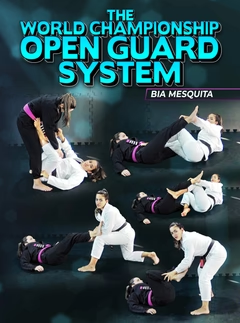
🥋 Study this open guard with Bia
This exact system — spider, lasso, De La Riva and their transitions — Bia turned into an instructional: The World Championship Open Guard System (BJJ Fanatics), the guard that won her 10 world titles, explained by the woman herself.
Transparency: affiliate link — it doesn’t change the price for you and supports BJJ-Rules.
Transitions, control and finishing: perfect continuity
The great secret of Bia Mesquita, what truly sets her apart from the other champions of her era, is not a spectacular isolated technique she would execute better than anyone. Nor is it a magic position only she would understand.
It is the absolute continuity of her game.
Many athletes are exceptionally strong in one precise technical zone: in the guard, in guard passing, or in back control. They excel in their preferred domain but struggle elsewhere. Bia, above all, masters the elusive in-betweens — those blurry zones of the fight where everything can tip either way.

In those chaotic moments between two codified positions.
In those instants where everything can swing one way or the other.
She stays perfectly calm and lucid. She picks the optimal option, adapts instantly, anticipates the next reaction.
When she passes the guard, it is clean and airtight. When she takes the back, it is stable and firmly locked. And when she attacks an armbar or a choke from the back, it is the logical, inevitable conclusion of an invisible sapping work patiently carried out over several minutes.
Nothing is forced.
Nothing is left to chance.
It is jiu-jitsu done “right”, in all its technical purity — in the same lineage of elegance as Roger Gracie, whose simplicity became an art.
Who were Bia Mesquita’s greatest rivals?
Bia Mesquita faced the biggest names of modern women’s jiu-jitsu. Her defining rivalries include Mackenzie Dern (whom she submitted in 64 seconds in 2017), Luiza Monteiro (2021 Worlds finalist), Bianca Basilio (defeated in the 2018 EBI final) and Gabi Garcia, the embodiment of raw power against her technique.
Against Mackenzie Dern: the duel of technicians
Two offensive technicians at the top of their art, two remarkable intelligences of movement and timing. During their intense rivalry, every meeting between Bia Mesquita and Mackenzie Dern was awaited by the worldwide jiu-jitsu community as a major stylistic clash. The defining moment remains their 2017 face-off at the Rio Falls Jiu Jitsu Open: Bia submitted Dern in just 64 seconds, a result that hit the community like an earthquake.
Against Gabi Garcia: technique versus power
This was the ultimate test of Brazilian Jiu-Jitsu. Not just a sporting test of physical performance and conditioning — almost a philosophical test of the very foundations of the discipline the Gracies popularized.
Refined technique against raw physical power.
Intelligent strategy against a massive frame.
Fluid creativity against crushing force.
Bia did not win all her matches against Gabi Garcia — far from it. Nobody can claim to systematically dominate an opponent with such a physical advantage. But she proved repeatedly, in striking fashion, that perfectly mastered technique can slow down, partially neutralize and sometimes even control a physically extraordinary opponent.
These intense, high-profile rivalries deeply shaped modern women’s jiu-jitsu. They showed the world that women’s jiu-jitsu could produce matches every bit as technical, strategic and thrilling as the men’s game.
What legacy does Bia Mesquita leave to women’s jiu-jitsu?
Bia Mesquita’s legacy goes far beyond her individual titles. She transformed the way women approach the open guard, proved that you can dominate durably through pure technique, and shattered the idea that women’s jiu-jitsu had to be explosive or power-based. She became a technical role model for an entire generation of practitioners around the world.
Today, when a young jiu-jitsu athlete diligently drills her spider guard in a small neighborhood club, obsessively polishes her open guard angles, chains fluid transitions between positions, or develops her own way of attacking the back, chances are she is imitating — directly or indirectly, consciously or not — the distinctive style of Bia Mesquita.

She profoundly changed how women approach the open guard in modern jiu-jitsu.
She proved beyond doubt that lasting dominance can be built on pure technique.
And she broke the preconception that women’s jiu-jitsu had to be explosive or primarily power-based.
Beyond sporting performance, Bia Mesquita carries a deep message about the accessibility of jiu-jitsu. As she likes to remind people: “What’s beautiful about jiu-jitsu is that it doesn’t only work the body, but also the mind. And it’s made for everyone. No matter your age, your physique or your level. It’s for everyone.” She embodies that inclusive philosophy through an accessible, reproducible technical style, proof that intelligence of movement can compensate for many physical disadvantages.
How did Bia Mesquita move into MMA and the UFC?
Bia Mesquita announced her transition to MMA in April 2023. She joined American Top Team in September 2023, then strung together five wins including the LFA women’s bantamweight title in June 2025. She signed with the UFC on July 30, 2025 and remains undefeated there: three wins in three fights, all by submission, propelling her into the UFC women’s bantamweight rankings.
A rigorous, accessible teacher
Like many great champions before her, Bia Mesquita also devotes a significant part of her time to daily teaching, international travel and technical seminars around the world. Bia does it with exactly the same rigorous mindset as in competition: always understand deeply before executing mechanically.
She doesn’t try to manufacture perfect clones of herself.
She teaches universal principles of jiu-jitsu.
Fundamental mechanics that work for everyone.
A different way of thinking about the game and its possibilities.
Her students unanimously describe a remarkably calm, composed teacher. Methodical in her pedagogy, she systematically takes the time to explain why a technical option works in a given context, how to set it up properly, and in which precise situations it becomes truly effective. She also passes on the patience she considers fundamental: “I learned to have patience, to keep moving forward, to stay focused on my goals and just go for it, see how far it can take me.”

The transition to MMA: a methodical progression
In April 2023, Bia Mesquita officially announced she had signed with First Round Management. A few months later, in September 2023, she joined American Top Team, one of the most prestigious MMA academies in the world. That decision made it clear she wasn’t coming to “try” MMA half-heartedly — she took it seriously from day one.
Bia made her professional MMA debut on June 15, 2024 at Spaten Fight Night, against Jorgina Ramos. She won by first-round submission. The message was clear: her world-class jiu-jitsu translates perfectly to the cage.
A spotless LFA run before the UFC
Bia then went on an impressive run at the Legacy Fighting Alliance (LFA), an organization known as a major springboard to the UFC:
October 18, 2024, LFA 194: first-round submission win over Shannel Butler.
December 7, 2024, LFA 198: second-round submission win over Fernanda Araujo.
March 6, 2025, LFA 203: second-round win by disqualification over Hope Chase.
June 20, 2025, LFA 211: second-round TKO win over Sierra Dinwoodie, claiming the vacant LFA women’s bantamweight title.
Five fights. Five wins. An LFA championship belt. All in just over a year. Logically, that run caught the attention of the most prestigious organization in the world.

Bia Mesquita’s arrival in the UFC: explosive debuts
On July 30, 2025, the announcement dropped: Bia Mesquita had signed with the Ultimate Fighting Championship. For many jiu-jitsu practitioners, seeing a legend of pure grappling join the most prestigious fight organization in the world was a powerful symbolic moment.
One of the greatest technicians of modern women’s jiu-jitsu wrote her name into the UFC roster.
Her UFC debut came on October 11, 2025 at UFC Fight Night 261, against Irina Alekseeva. Bia delivered exactly the fight everyone expected of her: a high-level grappling clinic, finished with a rear-naked choke in the second round. The performance immediately earned her a “Performance of the Night” bonus.
Three UFC fights, three submissions
On March 16, 2026 at UFC Fight Night 269, Bia followed up with a second emphatic win over Montserrat Rendon — again by rear-naked choke, this time in the first round. In April 2026, she entered the UFC women’s bantamweight rankings at number 15.
On June 20, 2026, at UFC Vegas 119, she faced Melissa Mullins — and lived through the scariest moment of her young MMA career. Badly rocked by a left hook early in the first round, she absorbed a flurry of punches that could have changed everything. But true to her “never give up” philosophy, she pulled Mullins into her guard, cleared the cobwebs and locked up an armbar at 3:16 of the first round. Three UFC fights, three submissions: her MMA record moved to 8 wins, 0 losses, and her climb toward the top 10 continues.
A unique technical arsenal for MMA
Bia Mesquita arrived in the UFC with an absolutely unique technical background.
- An elite grappling base forged over fifteen-plus years at the highest level,
- Ten IBJJF world titles at black belt (Guinness record),
- Exceptionally rare tactical intelligence,
- A deep understanding of transitions between positions.
Her jiu-jitsu, which ruled the mats for over a decade, becomes a fearsome threat the moment the fight hits the ground. In most scenarios where the fight ends up there, very few fighters can genuinely hope to match her in pure technique — the guard game is her home turf.
As she has always repeated: “You can never give up. In any situation, at any moment. You have to keep moving forward.” That mentality, which carried her to the summit of world jiu-jitsu, proved itself in the most beautiful way against Mullins: stunned on the feet, victorious on the ground.
Her arrival in the UFC is not just a new personal chapter in her career. It is a symbolic moment for women’s jiu-jitsu worldwide.

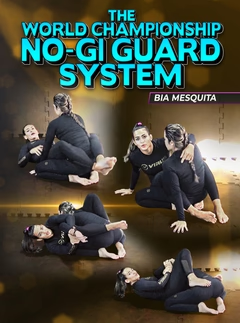
🥋 Bia’s guard, cage edition
The guard you see at work in the octagon is the no-gi version of her system: The World Championship No Gi Guard System (BJJ Fanatics) — grips, hooks and submissions adapted to no-gi and MMA.
Transparency: affiliate link — it doesn’t change the price for you and supports BJJ-Rules.
FAQ: everything about Bia Mesquita
Find here the answers to the most frequent questions about Bia Mesquita: her journey, her achievements, her style and her current UFC career.
Who is Bia Mesquita in Brazilian Jiu-Jitsu?
Bia Mesquita, born Beatriz de Oliveira Mesquita on April 7, 1991 in Rio de Janeiro, is a Brazilian jiu-jitsu competitor who holds the world record of 10 IBJJF black belt titles (recognized by Guinness). A black belt since 2011 under Letícia Ribeiro (Gracie Humaitá), she is considered one of the greatest technicians in women’s BJJ.
How many world titles has Bia Mesquita won?
Bia Mesquita holds ten IBJJF world titles at black belt, won between 2012 and 2021: eight at lightweight (2012-2016, 2018, 2019, 2021) and two in the absolute (2013, 2014). The record is officially recognized by Guinness World Records. In 2022, she was inducted into the IBJJF Hall of Fame.
What is Bia Mesquita’s style?
Her style rests on an exceptionally fluid open guard, blending spider guard, lasso guard and De La Riva in natural transitions. Her signature: millimetric distance control, always-precise grips and perfect continuity between defense and attack. She favors the finish (sweeps, triangles, omoplatas, rear-naked chokes) over points.
Who is Bia Mesquita’s coach?
Bia Mesquita has trained since her teens with Letícia Ribeiro, a legend of women’s jiu-jitsu, on the Gracie Humaitá team in Tijuca (Rio de Janeiro). Her black belt lineage runs through Carlos Gracie, Helio Gracie, Royler Gracie, Vini Aieta and Letícia Ribeiro. Since 2023, she also trains at American Top Team for her MMA career.
What is Bia Mesquita’s current MMA record?
Bia Mesquita holds a perfect professional MMA record of 8 wins and 0 losses. She is 3-0 in the UFC, with all three wins by submission: Irina Alekseeva (rear-naked choke, October 2025), Montserrat Rendon (rear-naked choke, March 2026) and Melissa Mullins (first-round armbar, June 2026 at UFC Vegas 119).
What was Bia Mesquita’s latest UFC fight?
On June 20, 2026, at UFC Vegas 119 (Las Vegas), Bia Mesquita defeated Melissa Mullins by armbar at 3:16 of the first round. Rocked by a left hook early in the fight, she turned the tables from her guard — her third submission in three UFC fights, moving her record to 8-0 and confirming her climb toward the women’s bantamweight top 10.
Why is Bia Mesquita considered a legend?
Bia Mesquita is considered a legend for several reasons: her Guinness record of 10 IBJJF world titles, her decade of dominance (2012-2021), her induction into the IBJJF Hall of Fame (2022), her influence on the playing style of an entire generation of practitioners, and now her successful transition to the UFC with a perfect record.
Conclusion: an elegance that marked jiu-jitsu history
Bia Mesquita never relied on easy media hype, calculated shock statements or spectacle for its own sake. Instead, she patiently built an exceptional, coherent career founded on impeccable technical precision and natural fluidity of movement.
Jiu-jitsu that is aesthetically beautiful, but above all fearsomely effective.
Refined in its expression, but never fragile under pressure.
Technical in its essence, but always perfectly realistic.
She embodies a truth that every jiu-jitsu practitioner eventually understands somewhere along their journey on the mats: technique perfectly executed, deeply understood and applied with tactical intelligence always wins in the long run.
Her message sums up her philosophy of life and combat: “You have to keep hope, stay focused on what matters to us, our goals, and just go for it. See how far it takes us.” That approach — humble and determined at once — carried Beatriz Mesquita to the absolute summit of her discipline, and now to the highest level of MMA.
And in the entire history of women’s jiu-jitsu, few have embodied that eternal truth with as much natural ease, technical mastery and inspiring elegance as Beatriz “Bia” Mesquita.
📬 Get ready for your first competition
Get our free PDF guide to preparing for your first BJJ competition + a weekly digest of Brazilian Jiu-Jitsu news, straight to your inbox.
Read next:
- Roger Gracie: When Simplicity Becomes Art
- Marcus “Buchecha” Almeida: The Giant with 13 Crowns
- All our BJJ legends profiles

Learn from the best: our recommended instructionals
The videos we actually recommend, hand-picked from the BJJ Fanatics catalog.
Bia Mesquita
The World Championship Open Guard System
The open guard behind 10 world titles, taught by Bia herself.
View on BJJ Fanatics →
Gordon Ryan
Systematically Attacking The Legs
Gordon Ryan's leg attack system: entries, control and finishes, nothing left to chance.
View on BJJ Fanatics →
Mica Galvão
Next Generation Closed Guard
Closed guard reinvented by the Brazilian prodigy: chained attacks at competition pace.
View on BJJ Fanatics →Disclosure: affiliate links. The price is the same for you and your purchase supports BJJ-Rules.