 EN
EN FR
FR PT
PT
Brazilian Jiu-Jitsu (BJJ) is a ground-fighting martial art born in Brazil in the early 20th century. In France today, it counts over 31,000 practitioners. But since 2024, the discipline has been caught in a conflict between two organizations: the CFJJB, which developed it for 20 years, and France Judo, which recently claimed to have legal authority to control it.
Behind this conflict lies a simple question: why create a competing structure to the CFJJB to develop BJJ in France? A story of takeover and refused recognition that needs to be told.
In this article6
A History Many Have Forgotten
David Giorsetti: The Pioneer
Over 25 years ago, when no structure existed and nobody talked about Brazilian Jiu-Jitsu in France, David Giorsetti traveled to Brazil to learn this martial art.

There, he trained alongside the Gracies. And he even had the incredible chance to roll with Hélio Gracie, founder of Brazilian Jiu-Jitsu, who was 86 years old at the time.
When he returned to France, he had no support, no infrastructure, no official recognition. But he had one conviction: Brazilian Jiu-Jitsu deserved to exist here, in its authentic form.
He taught, organized, trained the first instructors. He created a culture before creating a sport.
For the nostalgic, here’s a fight of David Giorsetti in December 1997. Many fighters of the new generation weren’t even born yet!
2004: The Birth of CFJJB
Together with a few other pioneers, David Giorsetti founded the French Confederation of Brazilian Jiu-Jitsu (CFJJB) in 2004.
The CFJJB wasn’t the result of a political agreement or institutional takeover. It was a grassroots creation, built to address three needs that nobody was covering:
- Organizing competitions adapted to BJJ
- Structuring instructor training
- Representing France with the IBJJF (International Brazilian Jiu-Jitsu Federation)
The goal was to structure the sport without distorting it. Train instructors according to international standards. Maintain the link with the IBJJF so that belts awarded in France would be recognized worldwide. Preserve that particular BJJ culture: open mats, community spirit, club autonomy.

In 2004, French BJJ consisted of a few hundred scattered practitioners. No structure, no organized competitions, and certainly no training programs. For 20 years, David Giorsetti and the CFJJB would build everything, methodically.
The Results, 20 Years Later
In 2025, the numbers speak for themselves:
- Over 31,000 licensed members (one of the strongest BJJ communities in Europe)
- Over 500 clubs spread across the entire territory
- 1,000 instructors trained via the CAF (Federal Instructor Certificate), a BJJ-specific diploma created by the CFJJB
- Partnership with the Île-de-France Region
- Organization of national and international competitions
- Strong link with the IBJJF: belts awarded in France are recognized worldwide
- Dozens of French athletes recognized internationally
All of this was done without ministerial delegation, without massive state subsidies, without the infrastructure of a major federation. Just the investment of clubs, the commitment of instructors, a pioneer’s vision, and a country of passionate people (we wrote an article about this).
It’s this man, with this background, that France Judo recruits in 2024.
2021: The Year Everything Changed
The Surprise Recruitment
July 2021. France Judo contacts David Giorsetti to create a global “jujitsu” structure within the federation, bringing together all its variations (Fighting System, Duo System, Newaza). Let’s note here that “Brazilian Jiu-Jitsu” differs in name and practice from “jujitsu,” whatever its form. This is actually one of the key points of this mess, and we’ll come back to it. Indeed, as David Giorsetti indicates, “Brazilian Jiu-Jitsu is a cousin of jujitsu” but it differs in ground fighting, which is at the heart of BJJ. It’s not the same sport.
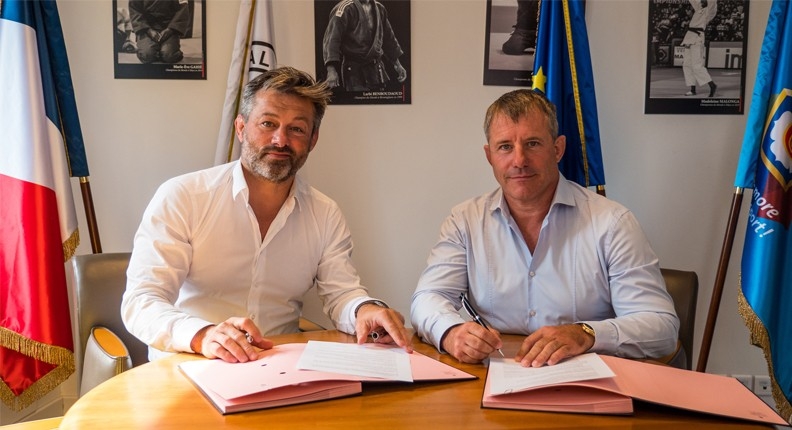
Giorsetti accepts France Judo’s proposal because he thinks he can contribute to a development that respects BJJ’s identity within the federation. But quickly, he discovers another reality.
The Break (2025)
In 2025, David Giorsetti publishes a letter to CFJJB members explaining why he’s breaking with France Judo:
“Recruited by France Judo to bring them my expertise, I refused to participate in a project without real dialogue, without budget transparency, without integration into strategic meetings, with centralized decision-making. Above all, I refused to be associated with a project that was actually just an attempt to distort Brazilian Jiu-Jitsu and take control of the CFJJB, with license transfers and forced integration into France Judo’s structure.”
The CFJJB then affiliates with ASPTT, a multisport federation approved by the ministry. Meanwhile, France Judo launches its own BJJ section, without the CFJJB, without the 31,000 members, and without the historic clubs.
What France Judo Says
In November 2025, David Inquel, France Judo’s national technical director, gives a long interview to defend his federation’s position. The discourse is well-rehearsed, the arguments carefully calibrated.
“We Have the Ministerial Delegation”
According to David Inquel: “The French Judo and Jujitsu Federation is the delegate for all jujitsu practices, including the Brazilian practice. The ministry confirmed this to us.”
For France Judo, it’s not about “taking over” BJJ, but exercising a public service mission. This mission gives them the power to issue official belts, organize French championship titles, support elite athletes with grants and athlete status.
David Inquel insists: “Belts in judo and jujitsu are state-issued belts. It’s like a high school diploma: your school prepares you, but it’s the state that issues the diploma.”
“We’re Going to Separate Judo and Jujitsu Belts”
France Judo also announces an expected decision: “We’re going to split belts between judo and jujitsu. When you’re a black belt in judo, you won’t automatically be a black belt in jujitsu anymore. It’s a real revolution within our federation.”
This separation, planned for the 2026 school year, addresses one of the BJJ community’s major criticisms: until now, a belt in judo automatically counted in jujitsu. So France Judo recognizes that judo differs from jujitsu. But not that jujitsu and Brazilian Jiu-Jitsu are two different things.
“We Respect BJJ Culture”
David Inquel, 5th dan judo, insists: “Brazilian vocabulary, black gis, music during training, belt promotions… all that is part of the culture. We don’t want to erase it. When I do judo, I like silence and the white gi. When I do BJJ, I like music and the atmosphere.” BJJ practitioners will surely appreciate that their sport is so misunderstood that it’s reduced, for David Inquel, to a good Brazilian party atmosphere on the mat…
“We’re Creating Specific Diplomas”
On instructor training: “The goal is to separate training so it’s linked to the discipline’s specificity. We’re going to create jujitsu CQPs, then BPs. And for those who’ve been teaching for 10-15 years, we’re planning VAEs rather than imposing a year of training.” We’ll come back to this point, but it seems hard to imagine a situation where experienced Brazilian Jiu-Jitsu practitioners would have to validate their experience with judokas to still have the right to teach.
“There’s Room for Everyone”
France Judo defends itself against wanting a monopoly: “We’re not in a monopoly. There are many federations we work with in judo: UNSS, UGSEL, FSCF, FSGT. We think we can reach 200,000 to 250,000 new practitioners. And we’re not against the CFJJB. There’s room for everyone.”
The stated ambition: “When we have 200,000 jujitsu practitioners in our federation, all the offerings we provide in judo (competitions, training, elite athlete support) will be deployed for jujitsu.”
David Inquel also mentions the 50,000 jujitsu practitioners already present in their federation. But beware: this figure encompasses ALL forms of jujitsu (Fighting System, Duo System, Newaza, etc.). This doesn’t specifically refer to Brazilian Jiu-Jitsu.
The Real Problem Isn’t Just What’s Being Proposed, But Also Who’s Proposing It
On paper, France Judo’s arguments are solid. Yes, state-recognized belts are needed. Yes, professional diplomas are needed to teach. A legal framework is needed to protect practitioners. Finally, subsidies are needed to develop elite level athletes.
Nobody disputes these objectives.
The real question lies elsewhere: why create a parallel structure rather than giving these resources to those who built French BJJ for 20 years?
New Practitioners: Development or Takeover?
France Judo announces it wants to “develop” BJJ. Meanwhile, the CFJJB already has 31,000 purely Brazilian Jiu-Jitsu members.
If the goal was really massive development, the logical approach would have been to support the existing structure that has proven itself. Give the CFJJB the means to access public subsidies, federal infrastructure, elite level programs.
Instead, France Judo creates a competing structure. Not to develop what doesn’t exist, but to take over what already exists.
Necessary State Diplomas… But at What Cost and By Whom?
Yes, state diplomas to teach are necessary. It’s protection for practitioners, a quality guarantee, a professional framework.
But let’s look concretely at what France Judo proposes: the CQP Martial Arts Instructor – Brazilian Jiu-Jitsu option, organized by Dojo Academy (France Judo’s training organization).
The teaching team:
- Bertrand Amoussou: 6th dan judo, “Judo instructor with BEES 1, Martial Arts, Jujitsu, MMA”
- Christophe Brunet: 6th dan judo, “Sports Teacher”, “State Diploma in Judo jujitsu”, “Brown belt in jujitsu”
Judokas, at least one with a brown belt in jujitsu, will train future Brazilian Jiu-Jitsu teachers. In judo, a brown belt would never train teachers. But for BJJ, France Judo considers this sufficient.
How will the training work? Candidates will have to pay €4,000 and follow 162 hours of training with judokas to obtain the right to teach. Their diploma will only allow them to teach up to… blue belt. We have to wonder if several (paid) levels will be necessary in the future to teach higher belts.
Meanwhile, the CFJJB’s CAF (Federal Instructor Certificate) has already trained 1,000 BJJ teachers, internationally recognized via the IBJJF.
Why not have supported this working system by helping it obtain official recognition? Why not have given the CFJJB the means to create its own CQP with BJJ black belt instructors, internationally recognized?
With a rate of €4,000 per training and hundreds of potentially concerned clubs, we understand the economic interest. This isn’t just about ministerial delegation but really an objective to take over a sport in full growth by a federation.
And on the ground, it’s also hundreds of clubs that will find themselves overnight without an instructor, unless they can pay €4,000 to obtain the CQP.
VAE for Experienced Teachers: An Administrative Absurdity
France Judo talks about VAE (Validation of Prior Experience) for experienced instructors. The principle is laudable: recognize experience rather than impose complete training.
But in reality: Vincent Nguyen (multiple champion, recognized instructor, IBJJF referee) or Laurence Cousin (pioneer of women’s French BJJ) would have to go through a VAE with an administrative file to be “recognized” by France Judo.
Imagine the scene: Vincent Nguyen before a jury to prove he knows how to teach BJJ. Laurence Cousin in training with judokas to validate her competence in Brazilian Jiu-Jitsu.

It’s exactly like asking Mbappé to get a football coach diploma issued by the handball federation. Technically, both sports are played with a ball. But well…
We used this example not without reason, despite the absurdity it represents, to add this: in the same interview, David Inquel compares Brazilian Jiu-Jitsu and Judo by drawing a parallel with Paddle and Tennis, quite seriously.
Why should French BJJ legends have to justify themselves to a structure that didn’t exist in this sport two years ago? Why not have given the CFJJB the power to issue these state diplomas themselves, with juries composed of real experts?
When Words Betray Ignorance
In the same interview, other details reveal the gap between discourse and ground reality.
David Inquel uses the terms “open map” instead of “open mat,” and “noji” instead of “no-gi.” These aren’t simple passing pronunciation errors. These are terms that every BJJ practitioner has used daily for years.
“Open mat” is the free training where everyone rolls together, without hierarchy, without an imposed program. It’s the heart of BJJ culture. “No-gi” is training without a kimono, the discipline that’s currently exploding with ADCC and UFC.
These vocabulary errors, coming from the national technical director supposed to lead Brazilian Jiu-Jitsu development (who is, for information, a blue belt), immediately reveal a lack of real practice, club attendance, immersion in the discipline.
And that’s the whole problem: you can’t authentically develop what you don’t intimately know.
In contrast, the BJJ-Rules team found a photo of David Giorsetti, CFJJB president, when he was a blue belt (around 1997, in Brazil), in the company of Rolker Gracie and Hélio Gracie, founder of Brazilian Jiu-Jitsu.

Why not have entrusted BJJ development to those who live this discipline daily, who naturally speak its vocabulary, who understand its codes?
Clumsy and Contemptuous Little Phrases
In the interview, David Inquel states: “We’ll talk about the CFJJB, so that’s dealt with.”
Dealt with. The word is out. For 31,000 members, 500 clubs, 20 years of construction, it’s a “subject to be dealt with.” Like an administrative detail we get rid of. Not a partner to listen to, not a community to respect. A problem to solve.
For the 31,000 CFJJB members, BJJ is not a “subject to be dealt with.” It’s their passion, their community, sometimes even an important part of their life.
How can you claim to develop a discipline you treat with such contempt? How can you claim to structure it when you don’t devote an ounce of attention to it on your own social networks, except for your own version/vision of “jujitsu”?
Wouldn’t it be more logical to entrust BJJ development to those for whom it’s not a “subject to be dealt with,” but the passion of a lifetime?
The Legal Gray Area
France Judo claims to hold the delegation for BJJ based on a “ministry confirmation.” But no published official document verifiably proves it.
The term “ju-jitsu” in their historical delegation could just as well refer to traditional Japanese ju-jitsu (which will be an Olympic discipline in 2028). Considering that this automatically includes Brazilian Jiu-Jitsu is an extensive interpretation.
Obviously, someone at the ministry didn’t take the time to understand that there’s a fundamental difference between traditional Japanese ju-jitsu and Brazilian Jiu-Jitsu. Two distinct disciplines, with different histories, techniques, belt systems, and completely different international federations.
France Judo rushes into this administrative gap and presents it as unquestionable legitimacy.
Questions That Remain Unanswered
Several gray areas persist. The BJJ community awaits clarifications.
On the Delegation
- Can France Judo publish the official ministry document explicitly mentioning “Brazilian Jiu-Jitsu” in its delegation?
- Why didn’t the ministry consider giving a direct delegation to the CFJJB?
- Is there still time to correct this decision and recognize the CFJJB as a legitimate structure?
On the 2021 Project
- What exactly were the terms of the project proposed to David Giorsetti?
- Did the project actually include a “license transfer” from the CFJJB to France Judo?
- Why wasn’t this project designed as support for the CFJJB rather than absorption?
Diplomas and Belts
- Why not have helped the CFJJB transform its CAF into a recognized state diploma?
- How does France Judo guarantee compatibility with the IBJJF system so that belts are recognized internationally?
Transparency
- Why didn’t David Giorsetti, recruited for his expertise, have access to strategic meetings or budget transparency?
- What is the exact budget allocated to BJJ development within France Judo for 2025-2026?
Conclusion: Recognition and Legitimacy
French BJJ is at a pivotal moment.
The real issue isn’t whether it should be structured with state diplomas and subsidies.
The answer is YES.
Yes, state-issued belts and recognized professional diplomas are needed. Yes, a solid legal framework is needed. And yes, subsidies for elite level are needed.
The real issue is knowing who should lead this structuring.
What the BJJ community is asking for is recognition.
Recognition of those who did the work. The possibility for the CFJJB to finally obtain the means it deserves: ministerial delegation, state diplomas it could issue with its own experts, subsidies to support its development.
The CFJJB isn’t perfect. No structure is. But it has something nobody else can claim: it was born from the ground, it was built by pioneers, it represents the soul of French Jiu-Jitsu. It possesses indisputable cultural and historical legitimacy.
A discipline doesn’t develop by pushing aside those who built it. It develops by finally giving them the tools to go further.
At a time when the sport is exploding worldwide, perhaps it’s this soul, and those who embody it, that must finally be recognized and supported.
Sources:
- Official letter from David Giorsetti to CFJJB members (2025)
- Interview with David Inquel, France Judo national technical director (November 2025)
- “On the Road” Podcast with Nicolas Renier and Vincent Nguyen (November 3, 2025)
- CFJJB official website (cfjjb.com)
Editor’s note: BJJ-Rules will continue to update the situation’s evolution, and we remain entirely available to CFJJB and France-Judo to provide clarifications or give them a voice.

Learn from the best: our recommended instructionals
The videos we actually recommend, hand-picked from the BJJ Fanatics catalog.

John Danaher
The Front Headlock System
Guillotine, anaconda, darce: the full front headlock system, from control to finish.
View on BJJ Fanatics →
Craig Jones
Power Ride: A New Philosophy on Pinning
Wrestling-style riding adapted to no-gi. Craig Jones, serious for once.
View on BJJ Fanatics →
Craig Jones
The Triangle Machine
The triangle from every position, with the adjustments that make it work against bigger opponents.
View on BJJ Fanatics →Disclosure: affiliate links. The price is the same for you and your purchase supports BJJ-Rules.