Leandro Lo: The Most Complete Competitor in BJJ History
Some athletes win titles. Others change a sport forever. Leandro Lo did both. Eight IBJJF world titles. Five different weight classes. A record that still stands in gi BJJ history. But beyond the...

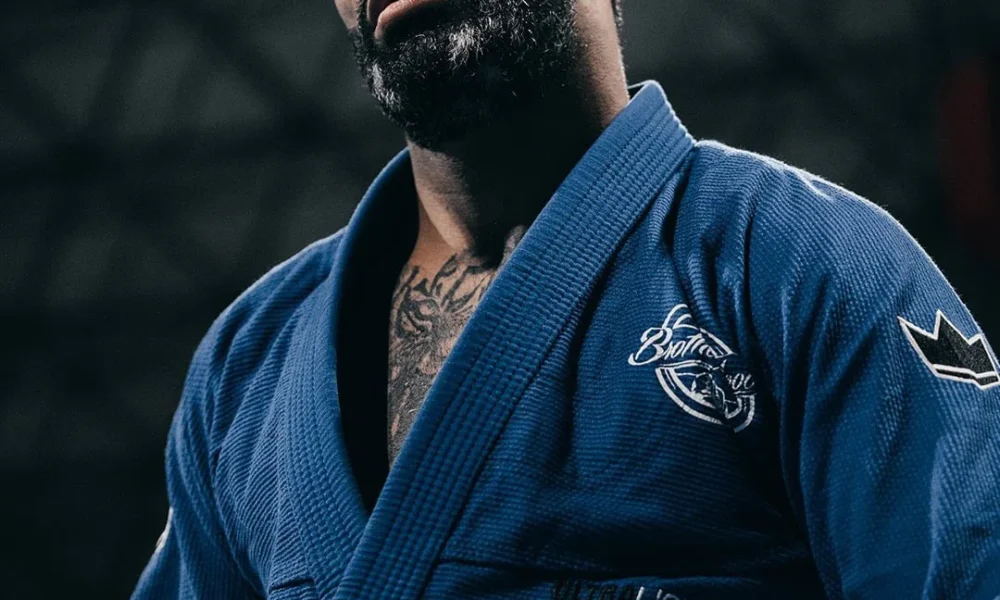
Some athletes win titles. Others change a sport forever. Leandro Lo did both. Eight IBJJF world titles. Five different weight classes. A record that still stands in gi BJJ history. But beyond the numbers, Leandro Lo represented something rarer: a competitor who made Brazilian jiu-jitsu beautiful to watch. Offensive, creative, relentless.
Table Of Content
- Where did Leandro Lo come from?
- How did Leandro Lo build his game?
- What is Leandro Lo’s competition record?
- Why did Leandro Lo found NS Brotherhood?
- Which rivals defined Leandro Lo’s career?
- The tragedy: what happened on August 7, 2022?
- Where does the legal case stand?
- What is Leandro Lo’s legacy in BJJ?
- Conclusion: Faixa Preta Nunca Morre
- FAQ: Leandro Lo
His tragic death in August 2022, at just 33 years old, left an immense void in the global BJJ community. Yet three and a half years later, his influence remains everywhere: in the academies teaching his guard passing, in the competitors who cite his name as inspiration, in the school program that bears his name in Brazil. You simply cannot tell the story of Brazilian jiu-jitsu without talking about Leandro Lo. This is his portrait.
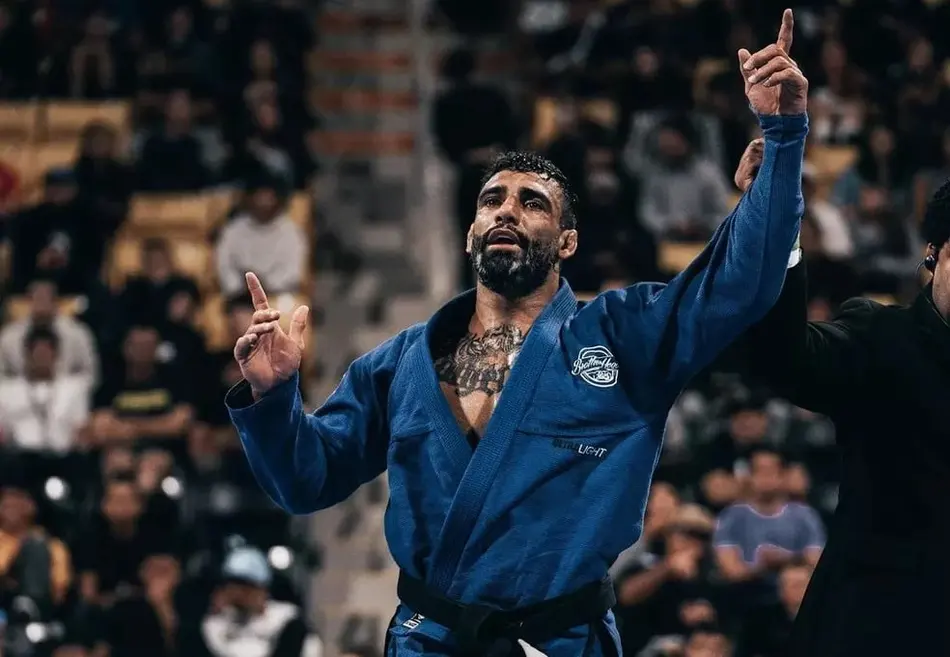
⚡ Profile — Leandro Lo
| Full name | Leandro Pereira do Nascimento Lo |
| Born | May 11, 1989, São Paulo, Brazil |
| Died | August 7, 2022 (age 33), São Paulo, Brazil |
| Nationality | 🇧🇷 Brazilian |
| Belt | Black (under Cicero Costha) |
| Team | NS Brotherhood (founder) / PSLPB Cicero Costha |
| Style | Offensive guard passing, spider guard, constant pressure |
| Lineage | Carlos Gracie → Hélio Gracie → Rickson Gracie → Marcelo Behring → Waldomiro Perez → Roberto Godoi → Marco Barbosa → Cicero Costha → Leandro Lo |
| Honor | IBJJF Hall of Fame (2023, posthumous) |
Where did Leandro Lo come from?
Leandro Lo was born on May 11, 1989 in the east zone of São Paulo, one of the most disadvantaged areas in Brazil’s largest city. His path to the top of world BJJ was therefore anything but written in advance. Yet it was a social project that changed everything.
From Capoeira to the social project: the kid from São Matheus
Before BJJ, there was Capoeira. Leandro practiced it for about two years in his neighborhood. But the kid wanted to compete, and Capoeira had no tournaments. So in 2004, at age 14, he joined the Projeto Social Lutando Pelo Bem (PSLPB), a program founded by instructor Cicero Costha to provide children from underprivileged backgrounds with free access to Brazilian jiu-jitsu. The name means “Fighting for Good,” and this project would become the forge of one of the greatest champions in BJJ history. As for Capoeira, it wouldn’t be forgotten: Leandro later explained that the discipline gave him a mobility and body awareness that helped him from day one in BJJ.
Living conditions at PSLPB were spartan. At its peak, up to fifteen competitors slept in the training room. No kitchen, just a microwave. The daily meal: plain canned tuna pasta, no sauce. In practice, whatever money they had went toward tournament entry fees, not food. It was precisely in this environment that Leandro Lo forged his hunger for victory, alongside future champions like the Miyao brothers, Yago de Souza and Wellington Luís. Years later, Lo would say of the Miyaos: “I have never seen anyone work as hard as those two. The hardest workers in the world.” Even after becoming an eight-time world champion, Lo continued to introduce himself as “o moleque do projeto” (the kid from the project). He never forgot where he came from, especially the São Matheus neighborhood where it all began.
One day in a steel mill, a lifetime on the mat
BJJ doesn’t pay at first. Leandro lived an hour and forty minutes from the academy, three buses each way. He sometimes didn’t have enough money to eat during the day and would wait for dinner at his mother’s house. When he lost his government allowance at 18, he tried one day of work at a steel mill: carrying iron, cutting iron, from 7 a.m. to 8:30 p.m., for 25 reais (roughly $5). One single day. The next morning, he called Cicero: “Please, find me a class to teach. If it pays for the bus, that’s enough. I don’t want to work.”
Cicero, for his part, didn’t let him stray toward conventional studies either. When Leandro told him he’d found a job, the response was immediate: “You’ll waste your talent and become just another guy.” When BJJ started interfering with school: “If jiu-jitsu is getting in the way of your studies, drop school.” Words many would call irresponsible. For Leandro Lo, they proved prophetic.
Leandro was, in any case, a natural athlete. From his earliest years, he piled up titles in junior divisions. IBJJF blue belt junior world champion in 2005, he returned to the podium in 2006. The talent was obvious. But it was an injury at purple belt that would truly shape the competitor he’d become.
How did Leandro Lo build his game?
Leandro Lo built his style by turning an injury into an opportunity. Initially known as a spider guard and triangle specialist at purple belt, he used a long competition break to develop the top game that would become his trademark at black belt.
That injury kept him away from competition mats for several months. Without the pressure of tournaments, Leandro devoted himself entirely to mat work. He studied the passers who inspired him: Jacaré and his toreando, Romulo Barral and his cross-grip from standing, and of course Cicero Costha himself, who taught exclusively standing guard passing. Lo fused these influences into a style uniquely his own: toreando, knee cut, constant pressure, lateral movement. It was during this period that the Leandro Lo the world would discover at black belt was born.
18 rounds a day: the champion’s forge
Lo’s training volume between 2009 and 2013 was staggering. The breakdown: three sessions a day. Six 8-minute rounds per session, with 2 minutes of rest between each. Plus 2 hours of daily technical drilling. That’s 18 rounds of sparring per day, on top of positional work. It was during this stretch that he reached what he called his “10,000 hours”: the tipping point where technique becomes instinct.
His training philosophy left no room for comfort. As he put it in his own words: “Rola para matar ou morrer.” In other words, roll to kill or die. No light rounds. He always started with the heaviest, most dangerous partners, then worked his way down in intensity. At PSLPB, everyone rolled with that mindset: “Todo mundo rola machucado, todo mundo rola cansado” (everyone rolls injured, everyone rolls tired). That was the culture of the room.
Forward pressure: the Leandro Lo trademark
The result of that forge was a style unique in competitive BJJ history. Leandro combined a flawless technical foundation with relentless physical intensity. His guard passing was both methodical and explosive, with a rare ability to chain attempts without ever releasing pressure. Above all, he possessed what commentators and coaches call “forward pressure”: a constant, tireless, suffocating advance on his opponent.
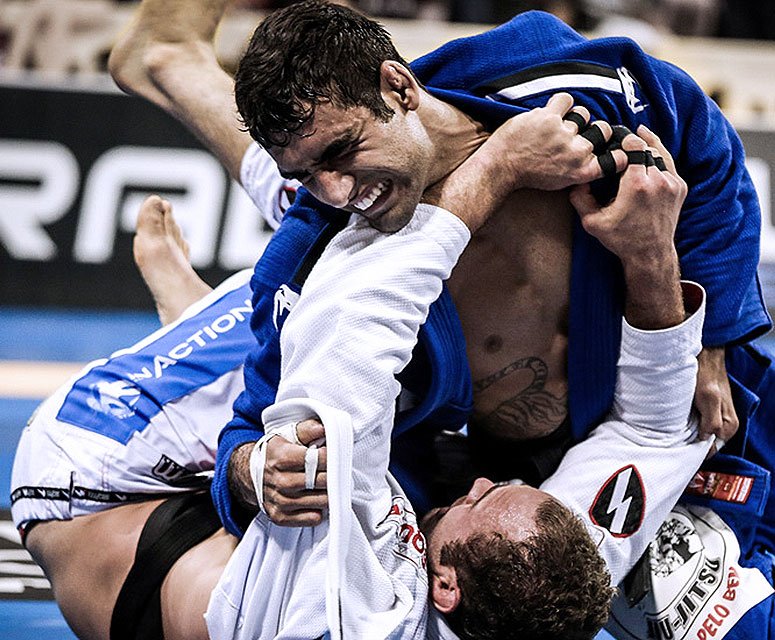
This offensive style set Leandro Lo apart from most high-level competitors. Where others looked to secure advantages and manage the score first, Lo pushed forward. Always. This approach made his matches thrilling to watch, even for a casual viewer. It’s also what made him one of the most popular athletes on the competitive circuit.
People remember how you fight, not your titles. That’s why everyone loved watching Leandro. He gave everything on the mat. He used all his weapons. The Leandro Lo style.
— André Galvão, Atos BJJ podcast (2022)
What is Leandro Lo’s competition record?
Leandro Lo’s record is one of the most impressive in gi BJJ history. Eight IBJJF world titles, gold medals in five different weight classes, and a dominance that spanned a full decade, from 2012 to 2022.
The takeoff: 2011-2013
It all started in April 2011. Leandro Lo, still relatively unknown on the international stage, defeated Michael Langhi at the UAEJJF World Pro. Langhi had been unbeaten in the lightweight division for three years. That single victory put Lo on the global BJJ map overnight. Galvão remembers his first reaction: “Leandro Lo? What kind of name is that? Who’s this skinny kid? And then I watched him compete and he was bringing an insane pace.”
That same year, he won the Brazilian Nationals. In 2012, the breakthrough came: his first IBJJF black belt world title at lightweight, defeating Lucas Lepri in the final. Lepri would go on to become one of his most consistent rivals. Lo then followed up with a second world title in 2013, again at lightweight. The dominance had begun.
Moving up in weight: 2014-2016
This is where Leandro Lo separated himself from the pack. Instead of staying comfortably in his weight class, he chose to move up. In 2014, he won the world title at middleweight. In 2015, he successfully defended it. Then in 2016, he moved up again and won at medium-heavyweight.
Three weight classes, five world titles in five years. Unprecedented in modern BJJ. On top of that, 2016 delivered another historic feat: Leandro Lo became the first triple Copa Pódio champion, winning the lightweight, middleweight, and heavyweight Grand Prix in the same year. Three divisions. Three titles. One season. Nobody had done it before. Nobody has done it since. Meanwhile, Lo gave up his own open weight dream at the Worlds that year, ceding his spot to his friend Buchecha. A sacrifice the public wouldn’t learn about until years later.
It was also in 2016 that Lo began seriously incorporating strength and conditioning into his routine. After a loss to Bernardo Faria in 2015, he told his teammate Yago de Souza: “I’m going to become Galvão or Barral.” He then took up weightlifting, “jail style” as he called it: 5×5 sets, explosive work, long compound movements to preserve mobility. The results were immediate: by 2016, he was reaching the open weight semifinals and realizing the difference was incomparable.
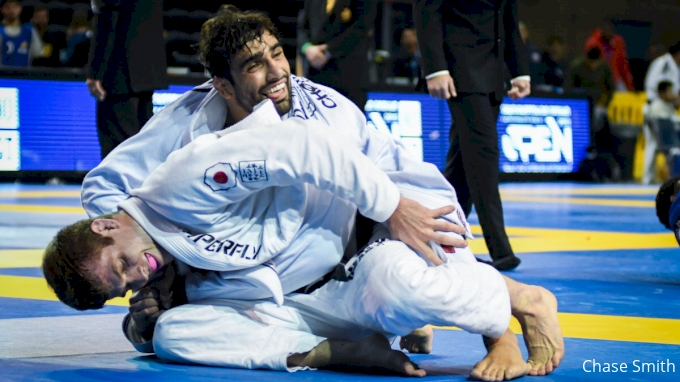
The record and the crowning achievement: 2018-2022
In 2017, Lo moved up to heavyweight and reached the world final, where he lost to Nicholas Meregali. The following year, at the 2018 Worlds, he was chasing Saulo Ribeiro’s record (titles in four different weight classes). After injuring his shoulder in the medium-heavyweight final against Mahamed Aly, he was forced to withdraw. Scheduled for the open weight final against Marcus “Buchecha” Almeida, Lo appeared doomed by his injury. But Buchecha, in a rare gesture of respect (typically reserved for teammates), chose to concede. Lo thus earned his first open weight title and his fourth title in a fourth weight class, tying Ribeiro’s record. A moment that spoke volumes about the respect Leandro Lo commanded, even from his most formidable opponents.
Lo himself didn’t fully count that title. In his interview with Galvão, he admitted: “I have one that I don’t really count, the one where I hurt my shoulder and Buchecha gave me the spot. That’s why I wanted to do another open: to actually win the final.” That honesty sums up the man: eight world titles, and yet he considered one of them incomplete.
The wilderness years: 2018-2021
The 2018 injury, however, opened a long period of doubt. Lo spent two years rebuilding his shoulder, his confidence, and his game. He described this period to Galvão without sugarcoating: the pre-training nausea, the body that wouldn’t cooperate, the fear of never coming back. “It took me two years for my head to adjust again. I was losing, but I was progressing a little each time. I was putting the pieces back together, one by one.”
In 2019, he finally broke the record by winning the title at heavyweight: five different weight classes at the IBJJF Worlds. A historic achievement. Then in June 2022, Lo claimed his eighth world title, a full decade after his first black belt coronation. He returned transformed: more muscle, more explosiveness, and above all, a mental maturity forged through years of doubt. It would be his last tournament.
🏆 Leandro Lo by the numbers
| IBJJF World titles | 8 |
| Weight classes (Worlds) | 5 (record) |
| IBJJF Pan titles | 8 |
| Copa Pódio (Grand Prix) | 6 (triple crown 2016) |
| Brazilian Nationals | 3 |
| Years of dominance | 2012–2022 (10 years) |
| IBJJF Hall of Fame | 2023 (posthumous) |
Why did Leandro Lo found NS Brotherhood?
Leandro Lo founded NS Brotherhood in 2015 to build a project in his own image: offensive, ambitious, focused on high-level competition. The “New School” name reflected his vision of a modern BJJ where technique and physical intensity go hand in hand.
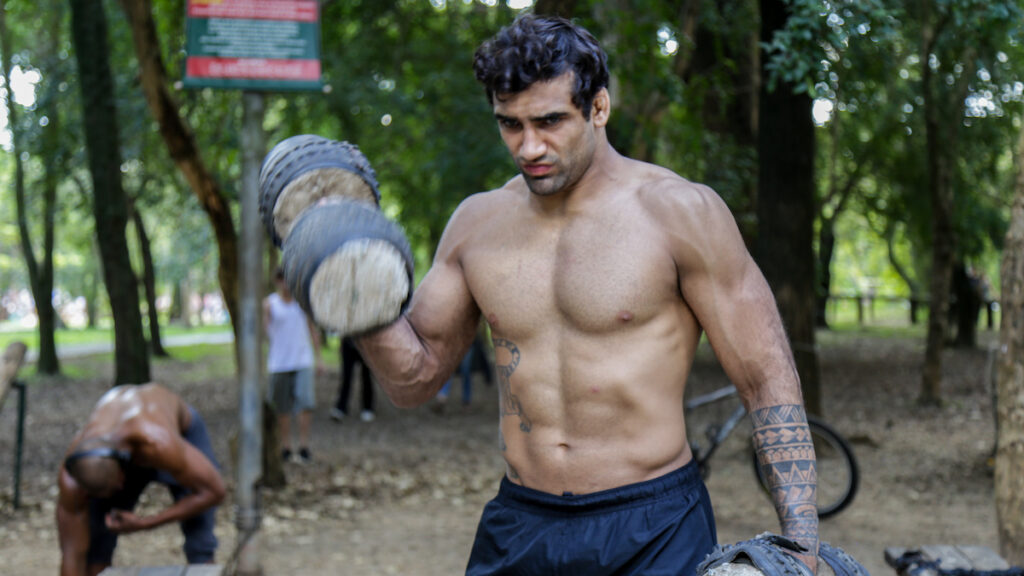
After years at PSLPB Cicero Costha, the academy where it all began, Leandro felt the need to strike out on his own. The split with Cicero Costha wasn’t a conflict, though; rather, it was a natural evolution. Lo wanted to build his own structure, attract elite competitors, and pass on his philosophy of BJJ.
NS Brotherhood quickly attracted top-tier names. Among the athletes who left PSLPB with Leandro were Luiza Monteiro, Helio Dias, Gustavo “Braguinha,” Ygor Schneider, Anderson Lira and Wellington Luís. The project was built on a core belief: the bonds forged on the mat go beyond BJJ. The team established itself on the international stage, confirming that Leandro Lo was not only an exceptional competitor, but also a leader capable of building a collective project.
Which rivals defined Leandro Lo’s career?
Leandro Lo’s career was marked by rivalries that shaped the history of competitive BJJ. Each weight class move brought him face to face with new opponents, and each rivalry revealed a different facet of his talent.
Lucas Lepri. The longest-running rivalry. The two clashed multiple times at lightweight, with Lo holding the overall edge. Lepri, a meticulous technician and multi-time world champion himself, was the perfect mirror: two different styles, an identical level. Their Worlds finals remain among the finest of the modern era.
Michael Langhi. Lo’s victory over Langhi at the 2011 World Pro was the starting point of everything. Langhi had been the man to beat for three years. Dethroning him launched Leandro into another dimension.
Nicholas Meregali. The only Worlds final that Lo lost decisively, in 2017, at heavyweight. Meregali, with his size and dominant guard player game, represented the ceiling of Lo’s weight class ascent. Yet that defeat only deepened the mutual respect between the two men.
Lo and Buchecha: more than a rivalry
Marcus “Buchecha” Almeida. More than a rivalry: a brotherhood. The matchup between Lo and Buchecha, especially at open weight, symbolized the clash between Lo’s mobile technique and Buchecha’s raw physical power. Two fighting philosophies. Two legends.
What the public remembers most is Buchecha’s gesture at the 2018 Worlds, when he conceded the open weight final to an injured Lo. But what nobody knew was that in 2016, it was Lo who had taken the first step. Buchecha revealed it after Leandro’s death: “Nobody saw what he had done in 2016, when he gave up his dream and let me go straight to the open weight final.” The 2018 gesture was not a gift. It was a return. Buchecha described Lo as “a brother” and “an enlightened human being, off the mats too.” For the full story from Buchecha’s perspective, including the complete 2016 Worlds scene and the reaction from his coach Leo Vieira, read our portrait of Marcus “Buchecha” Almeida.
The tragedy: what happened on August 7, 2022?
On August 7, 2022, Leandro Lo attended a social evening at Clube Sírio (a social club in São Paulo’s Indianópolis neighborhood) where pagode group Pixote was performing live. He was with friends. The mood was relaxed.
According to witnesses and the police investigation, a man approached Leandro’s table and started an altercation. The man was Henrique Otávio Oliveira Velozo, a São Paulo military police lieutenant, off duty and in civilian clothes. Lo attempted to de-escalate by taking him down and restraining him on the ground, then released him. Velozo stood back up, however, drew a concealed weapon and shot Leandro Lo in the head.
The champion was rushed to hospital, where he was declared brain dead. Leandro Lo died at 33, at the peak of his career, less than two months after winning his eighth world title. Just weeks earlier, in his interview with Galvão, he had spoken of opening his own academy at 35, of transitioning from competing to teaching. He would never get the chance.
Velozo turned himself in to the military police internal affairs office the following day. He was placed in preventive detention at the Romão Gomes military prison in São Paulo.
Leandro Lo’s funeral was held on August 9, 2022 at the Morumbi cemetery in São Paulo. Dozens of athletes in gis formed an honor guard from the open casket to the grave. The global BJJ community was in shock.
Where does the legal case stand?
The legal proceedings have seen numerous twists since 2022. Here are the facts as documented by Brazilian and international sources.
In the days following Lo’s death, the BJJ community mobilized. Buchecha launched a manifesto signed by teams, athletes, specialized media and the family, demanding an impartial investigation and a fair trial, free of any privilege tied to the suspect’s military police status. Manifesto, shared worldwide, showed the scale of the shock caused by the case.
The trial and controversial acquittal
The São Paulo public prosecutor’s office initially charged Velozo with qualified homicide with three aggravating circumstances (vile motive, cruel means, inability of the victim to defend himself). However, the trial, originally scheduled for May 2025, was postponed twice due to procedural incidents.
The trial ultimately took place from November 12 to 14, 2025 at the Barra Funda Criminal Forum in São Paulo. After three days of hearings, the popular jury (five women, two men) acquitted Velozo by accepting the self-defense argument presented by his legal team. The officer was consequently released on November 15, 2025.
The verdict sent shockwaves through the global BJJ community. Fátima Lo, Leandro’s mother, stated that she had “buried her son a second time.” The public prosecutor announced an appeal. The family’s attorney challenged Velozo’s version and confirmed their intent to continue the legal fight.
Latest known development: in March 2026, a São Paulo court unanimously upheld Velozo’s dismissal from the military police. Although acquitted in criminal court, the police’s Justification Council had deemed him unfit to serve as an officer. The criminal appeal remains ongoing.
What is Leandro Lo’s legacy in BJJ?
Leandro Lo’s legacy extends far beyond competition. He changed the way an entire generation of practitioners thinks about offensive BJJ, and his impact continues to be felt in academies around the world.
A technical model
Leandro Lo’s guard passing has become a pedagogical reference. His toreando, his knee cut, his ability to chain passing attempts without pause: all of it is now part of the curriculum at countless academies worldwide. For instructors and competitors alike, studying Lo’s game means studying the essence of offensive gi BJJ. His style echoes that of Roger Gracie in one essential way: the apparent simplicity masked an absolute technical mastery.
A social symbol
The story of Leandro Lo, a child from one of São Paulo’s poorest neighborhoods who became a world champion thanks to a social project, embodies the promise of BJJ as a tool for social transformation. The Projeto Social Lutando Pelo Bem founded by Cicero Costha, which produced Lo, continues its work. In October 2024, the city of Belo Horizonte launched the “Leandro Lo — BJJ in Schools” program, using his story as inspiration to introduce jiu-jitsu in public schools.
His family and close friends (notably Buchecha and his sister Amanda Lo) also created the Instituto Leandro Lo to carry on what had always been Leandro’s dream: helping young people become athletes and make a living through sport, just as he did starting from the São Matheus neighborhood. The initiative carries forward the legacy of “o moleque do projeto” by giving other children the same chance that Cicero Costha once gave Leandro.
Worldwide recognition
In May 2023, the IBJJF inducted Leandro Lo into its Hall of Fame posthumously, alongside legends like Roger Gracie and Marcelo Garcia. The UAEJJF also paid tribute for his multiple World Pro titles. At the 2022 Worlds and 2022 ADCC, moments of silence were observed in his memory. Around the world, competitors still wear patches and gis bearing his image. The phrase “Legends Never Die,” adopted by the BJJ community, has become inseparable from his name.
In their words: those who knew him
Leandro Lo was one of the greatest in our sport. A true example of a black belt, martial artist and champion on and off the mats. Rest in peace, legend.
— IBJJF, official statement (August 2022)
Descanse em paz Leandro. Só agora paro, sento e vejo o quanto é significativo para mim um dia ser admirado por você. Lembro de quando você falava para eu treinar menos, lembro quando você comprou um moletom pra mim, pois não tinha dinheiro, lembro de você enfurecido em raros treinos que não conseguia passar minha guarda… mas o que vai ficar mais marcado para mim é a maneira como encarava o ato “viver”. Obrigado por tudo. Faixa preta nunca morre.
Rest in peace Leandro. Only now do I stop, sit down, and see how meaningful it was to me to be admired by you one day. I remember you telling me to train less, I remember you buying me a sweatshirt because I had no money, I remember you furious those rare times you couldn’t pass my guard… But what will stay with me most is the way you approached the act of living. Thank you for everything. Black belts never die.
— João Miyao (August 2022)
Vivendo o presente! Guardo isso comigo, não gosto de economizar nada nesta vida. Tudo que eu tenho é o agora.
Living in the present! I keep this with me. I don’t like saving anything in this life. All I have is now.
— Leandro Lo
Conclusion: Faixa Preta Nunca Morre
Leandro Lo is not just a champion. He’s a benchmark. A reference point for everyone who believes BJJ should be offensive, spectacular, and accessible. A kid from a tough São Paulo neighborhood who worked one day in a steel mill before deciding his life would be on the mat, and who proved that talent, combined with work ethic and a supportive environment, can take you to the top of the world.
Three and a half years after his passing, his influence remains intact. His guard passing is still studied, his name still chanted. His story continues to inspire thousands of practitioners who step onto the mat every day, in academies across the globe. Leandro Lo was taken from BJJ far too soon. But what he built on the mat will never disappear. Faixa preta nunca morre.
FAQ: Leandro Lo
How many world titles did Leandro Lo win?
Leandro Lo won eight IBJJF black belt world titles between 2012 and 2022. He also holds the record for the most different weight classes at Worlds: five (lightweight, middleweight, medium-heavyweight, heavyweight, and open). To learn more about belts and progression in BJJ, check out our guide on the BJJ belt system.
What was Leandro Lo’s fighting style?
Leandro Lo was best known for his offensive and relentless guard passing, influenced by Jacaré, Romulo Barral and Cicero Costha. His toreando and knee cut were technical benchmarks. Earlier in his career, he was also recognized for his spider guard and triangles. What set him apart was his forward pressure: a permanent, physical, suffocating advance that left opponents gasping.
Who trained Leandro Lo in BJJ?
Leandro Lo received his black belt from Cicero Costha, founder of the Projeto Social Lutando Pelo Bem (PSLPB) in São Paulo. This social project provided free BJJ access to children from disadvantaged backgrounds. Before BJJ, Lo had practiced Capoeira for two years. In 2015, he founded his own team, NS Brotherhood, while maintaining a relationship of respect with Costha.
How did Leandro Lo die?
Leandro Lo was fatally shot on August 7, 2022 at the Clube Sírio in São Paulo, during a social evening with live music. The shooter, an off-duty military police lieutenant in civilian clothes, was arrested the following day. After a trial in November 2025, the jury acquitted the officer on self-defense grounds. Lo’s family and the public prosecutor have announced an appeal.
Is Leandro Lo in the IBJJF Hall of Fame?
Yes. In May 2023, the IBJJF inducted Leandro Lo into its Hall of Fame posthumously, on what would have been his 34th birthday. He joined legends such as Roger Gracie and Marcelo Garcia. The UAEJJF also honored him for his World Pro titles.
What is Leandro Lo’s legacy in BJJ?
Leandro Lo’s legacy is threefold. Technically, his guard passing remains a reference in academies worldwide. Socially, his journey from a social project to the top of the world inspires thousands of young practitioners. Symbolically, the phrase “faixa preta nunca morre” (black belts never die), adopted by the Brazilian community, has become inseparable from his name. A school program bearing his name was launched in Belo Horizonte in 2024, and the Instituto Leandro Lo continues his mission of helping young athletes.
For more, read our portrait of Marcus “Buchecha” Almeida, our article on Roger Gracie, our portrait of Marcelo Garcia, our guide to the history of BJJ in 10 key dates, and the official Leandro Lo and NS Brotherhood website.