

Brazilian Jiu-Jitsu Belt System: Meaning of Each Belt
In Brazilian jiu-jitsu, the belt isn’t an accessory. It’s a marker. It tells where you’ve been, what you’ve been through, and how committed you are to this martial art. But...

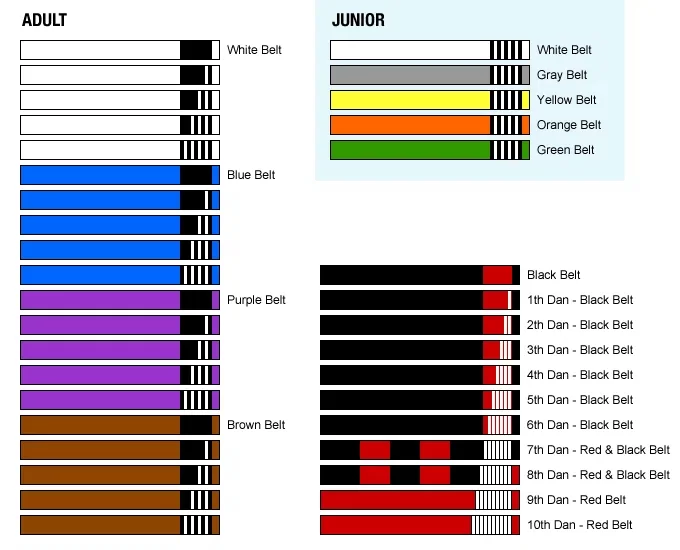
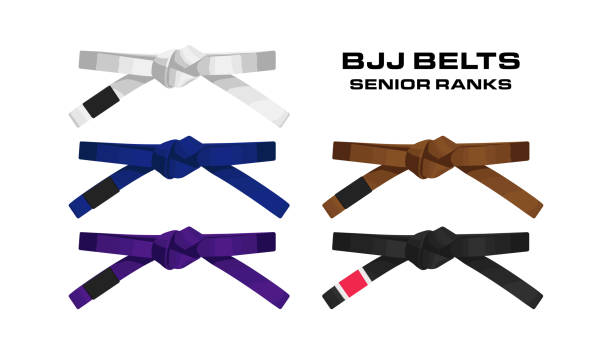
In Brazilian jiu-jitsu, the belt isn’t an accessory. It’s a marker. It tells where you’ve been, what you’ve been through, and how committed you are to this martial art. But unlike judo or karate, the BJJ belt system is deliberately slow. There are only five adult ranks (white, blue, purple, brown, black), and each one can take years.
Table Of Content
That’s actually what makes BJJ unique: belts aren’t handed out for showing up. They’re given when the practitioner is ready — technically, physically and mentally. And it’s the instructor, and only the instructor, who decides. There’s no official exam, no standardized checklist. Every promotion is an act of trust between a coach and their student.
In this article, we break down what each belt represents, how long it typically takes to earn, and what’s really expected of you at every stage. If you’re brand new and looking for a broader overview before stepping on the mat, start with our complete guide to your first BJJ class.
Kids’ Belts in BJJ
Before we get into the adult system, a quick word on kids. Children can start BJJ as early as age 4, with a dedicated belt system defined by the IBJJF. This path goes from white belt to green belt, with several intermediate ranks along the way.
Kids’ ranks in detail
The system is progressive and designed to keep young practitioners motivated. Each color is divided into three sub-levels (for example: grey-white, grey, grey-black), and stripes are added between ranks to mark progress.
The white belt is the starting point for all kids — learning basics and discipline. Grey belt is the first real promotion. The yellow belt shows growing mastery of fundamentals. The orange belt, typically accessible around ages 10-14, marks a more assertive style. Finally, the green belt is the last kids’ rank, preparing the transition to the adult path.
Progression doesn’t depend solely on time. Consistency, attitude and the ability to apply techniques all count. If you’re considering enrolling your child, we wrote a dedicated piece: BJJ for Kids: Confidence, Discipline & Respect.
The White Belt: Where It All Begins
Everyone starts here. The white belt is your baptism by fire. And let’s be honest: it’s probably the hardest phase. Not technically — nobody expects much of you at this stage — but mentally. You’re going to get submitted. A lot. By everyone. And that’s completely normal.
What’s expected of a white belt
The goal isn’t to master everything. It’s to survive and learn how to learn. Concretely, you’ll be expected to know the fundamental positions: closed guard, half guard, mount, side control, back control. You’ll learn basic escapes, control principles, and a few simple submissions.
But beyond technique, mindset matters most. A good white belt is someone who keeps showing up. Who accepts getting tapped without getting discouraged. Who watches, asks questions, and improves step by step. In BJJ, persistence beats raw talent every time.
Average duration: 1 to 2 years before promotion to blue belt, training 2-3 times per week.

The Blue Belt: Building Foundations
The blue belt is a relief. You survived the baptism. You’re starting to understand what’s happening on the mat. You land your first submissions, escape bad positions, and begin to dominate white belts. It’s an exciting moment.
The “blue belt blues” trap
But it’s also the rank with the highest dropout rate. It’s called the “blue belt blues.” Why? Because the novelty has worn off. Progress slows down. Purple and brown belts are still miles ahead, and the road to black seems endless. Many practitioners quit at this stage — it’s a well-known pattern.
Those who push through are the ones who find motivation beyond the belt itself: the joy of rolling, competing, teaching, or simply the routine. This is where you start developing a personal game. You identify guards you enjoy, submissions that click, and sequences that become your weapons.
If you’re a blue belt going through a rough patch, check out our piece on how to improve training just twice a week. Sometimes the issue isn’t your level — it’s your rhythm.
Average duration: 2 to 3 years at blue belt before promotion to purple.

The Purple Belt: Defining Your Game
The purple belt marks a real turning point. You’re no longer a beginner. You’re recognized in your academy as someone who knows what they’re doing. Your game becomes more fluid, more instinctive. Sequences flow naturally.
A recognizable game
Most purple belts have an identifiable “game.” A preferred guard — De La Riva, half guard, butterfly. A go-to strategy — pressure passing or playing from the bottom. Signature moves that people recognize within seconds of the round starting. This is where you build your identity as a grappler.
It’s also the stage where many start teaching. Helping beginners, explaining a technique, correcting a position — it’s part of the journey. In fact, teaching is often the best way to truly understand what you’re doing.
But purple belt isn’t just about technique. It’s also a test of patience. Progress is less visible than before. You might plateau for months. At this level, improvement is measured in details, not revelations. It’s a refining process, not a discovery phase.
Average duration: 1.5 to 3 years at purple belt.

The Brown Belt: The Final Step
Brown belt is often described as the details phase. The big technical discoveries are behind you. What changes is precision, timing, and efficiency. You know what you’re doing — now you’re learning to do it better.
Refining every movement
At this level, you learn to conserve energy. You use the right timing instead of force. Every movement becomes cleaner, sharper. Your game turns subtle, intelligent, and mistakes become rare. You also become a role model for lower belts — white and blue belts watch you and draw inspiration from how you move.
Brown belt is also a period of mental consolidation. You develop a calm, strategic mind. You learn to analyze your rolls with distance. And you start preparing — consciously or not — for what comes next.
In competition, brown belts often face black belts in open tournaments. It’s a valuable reality check: can you hang with the best? If so, the next rank isn’t far away.
Average duration: 1 to 2 years at brown belt before promotion to black.

The Black Belt: A New Beginning
Contrary to what many think, the black belt isn’t the finish line. It’s the beginning of a new chapter. The practitioner is recognized for their technique, experience, and ability to pass on knowledge. You’re no longer just a student — you become an ambassador of the art.
What the black belt truly represents
It takes an average of 8 to 12 years of consistent training to earn a BJJ black belt. That’s significantly longer than most other martial arts. That’s also why it carries so much weight — when someone wears a BJJ black belt, you know they’ve gone through years of work, doubt, and self-questioning.
The black belt is then divided into degrees, reflecting seniority and continued engagement. A first-degree is a fresh black belt. A fifth or sixth-degree is a master with decades of practice. People often say you only start truly understanding jiu-jitsu at black belt. The path only deepens from there.
To see what that looks like at the highest level, explore the journeys of Buchecha (13 world titles), Roger Gracie (simplicity as art), or Marcelo Garcia (the butterfly guard master). Each embodies a different facet of what the black belt can become.

The Belts Above Black
Beyond the black belt, BJJ recognizes seniority, contribution to the art, and the transmission of its values. These belts don’t reward performance — they honor a life dedicated to jiu-jitsu.
The red and black belt (7th degree)
Also called the “coral belt,” this rank is awarded to practitioners who reach the 7th degree of black belt. It represents at least 30 years of practice after earning the black belt. It alternates red and black stripes.
The red and white belt (8th degree)
Even rarer. This belt is given to masters who reach the 8th degree. Those who wear it have dedicated the better part of their lives to BJJ as teachers and ambassadors.

The red belt (9th and 10th degree)
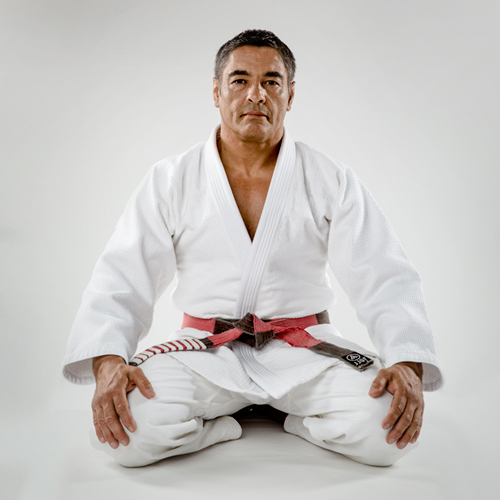
Red belt is the highest distinction in BJJ. The 9th degree is awarded to exceptional masters. The 10th degree is strictly reserved for the pioneers — the Gracie brothers who founded the art. No other practitioner can achieve it today. Rickson Gracie, long a coral belt holder, now wears the red belt.
How Long Does Each BJJ Belt Take?
This is the question everyone asks. Here are the average timelines, assuming 2-3 training sessions per week. These vary depending on the academy, instructor, training frequency and competition involvement.
| Promotion | Average duration | Cumulative time |
|---|---|---|
| White → Blue | 1 to 2 years | 1-2 years |
| Blue → Purple | 2 to 3 years | 3-5 years |
| Purple → Brown | 1.5 to 3 years | 5-8 years |
| Brown → Black | 1 to 2 years | 8-12 years |
A few important notes. First, these are averages. Some elite competitors earn their black belt in 5-6 years (the Ruotolo brothers, for example). Other recreational practitioners take 15 years or more — and there’s absolutely no shame in that. Second, there’s no “right” pace. BJJ is a marathon, not a sprint. What matters is consistency and quality, not speed.
Finally, a point many people overlook: the IBJJF enforces minimum time requirements between ranks. For instance, you must spend at least 2 years at blue, 1.5 years at purple, and 1 year at brown. But most instructors go well beyond these minimums.
Frequently Asked Questions
Can you skip a belt?
In theory, no. The IBJJF system requires sequential progression. In practice, some high-level athletes (wrestlers, judokas) may receive a blue or purple belt quickly if their skill level warrants it. But it’s rare and always at the instructor’s discretion.
Who decides when you get promoted?
Your instructor. There’s no official exam in BJJ. No kata to demonstrate, no panel of judges. Your coach observes your progress over months and years, and decides when you’re ready. It’s a trust-based system — which is why choosing the right academy matters so much.
Are stripes mandatory?
No. Stripes are a progress indicator between two belts, but not every academy uses them. Some give four stripes before each promotion. Others skip them entirely and hand out belts when the time is right. Both approaches are valid.
Does your belt count in No-Gi?
Yes. Your rank stays the same regardless of format. In no-gi competition, you compete at your belt category. The only difference: you don’t physically wear the belt during training or matches.
Our Take at BJJ-Rules
Let’s be real: the belt matters. Pretending otherwise would be dishonest. When you receive your blue after two years of struggle, when you see the purple coming after years of grinding, when your coach ties the black belt around your waist one day — those moments are powerful. They matter. And they deserve to be celebrated.
But the belt doesn’t tell the whole story. It doesn’t say whether you’re a good training partner and doesn’t say whether you help beginners. It doesn’t say whether you keep learning with humility. The best practitioners we know aren’t always the highest-ranked — they’re the ones who make the mat a better place by being on it.
So yes, chase the next belt. Work for it. But don’t forget that the real rank is what you do between promotions. It’s the quality of your daily commitment. And if you need a reminder of why you started in the first place, go read our piece on the history of BJJ in 10 key dates. It puts things in perspective.

Follow all BJJ news on BJJ-Rules — France’s #1 Brazilian Jiu-Jitsu media.
Read also: Complete Guide to Your First BJJ Class | How to Choose Your First Academy | How to Improve Training Twice a Week