


BJJ vs Judo: What’s the Difference? The Complete Guide
By BJJ-Rules | March 2026 Meta description: BJJ vs Judo: what are the real differences? Rules, techniques, philosophy — the complete guide to understanding two martial arts born from the same roots....

By BJJ-Rules | March 2026
Table Of Content
- BJJ vs Judo: What’s the Difference? The Complete Guide
- BJJ vs Judo: A Shared History, From Japan to Brazil
- BJJ vs Judo Rules: Two Sports, Two Logics
- BJJ vs Judo Techniques: Standing or on the Ground
- BJJ vs Judo Uniform: Gi, Kimono, and No-Gi
- Philosophy and Culture: BJJ vs Judo, Two Different Worlds
- Competition: From the Dojo to UFC BJJ
- BJJ vs Judo for Self-Defense: Who Wins in the Street?
- BJJ vs Judo: Which Martial Art Should You Choose?
- From Judo to BJJ: A Natural Transition
- BJJ vs Judo: Myths vs Reality
- FAQ — BJJ vs Judo
- Conclusion — Two Arts, One Respect
Meta description: BJJ vs Judo: what are the real differences? Rules, techniques, philosophy — the complete guide to understanding two martial arts born from the same roots.
BJJ vs Judo: What’s the Difference? The Complete Guide
You’ve watched a grappling match and wondered: “Why is one guy trying to throw the other, and the other one just sits down?” If this BJJ vs Judo question has ever crossed your mind, this article is for you.
BJJ vs Judo is probably the question we get asked the most. The short answer: they share the same DNA but have evolved in radically different directions. The long answer is this complete guide to BJJ vs Judo.
Let’s get one thing straight from the start: we’re not here to play the “one is better than the other” game. Judo is a beautiful martial art that has produced some of the most impressive athletes in combat sports history. Brazilian Jiu-Jitsu, on the other hand, has revolutionized the way the world understands ground fighting. Both deserve respect. But they don’t offer the same thing — and that’s exactly what we’re going to break down here.
BJJ vs Judo: A Shared History, From Japan to Brazil
You can’t understand the differences between BJJ and Judo without going back to the source. And the source is Japan, in the late 19th century.
Jigoro Kano and the birth of Judo
In 1882, Jigoro Kano founded Kodokan Judo in Tokyo. His idea was revolutionary for the time: take the techniques of traditional Japanese jujutsu, remove the most dangerous ones, and create a system of physical and moral education accessible to everyone. Judo wasn’t just a fighting art — it was an educational project. The famous “Seiryoku Zenyo” (maximum efficiency, minimum effort) and “Jita Kyoei” (mutual welfare and benefit) aren’t just slogans: they’ve shaped Judo’s philosophy for over a century.
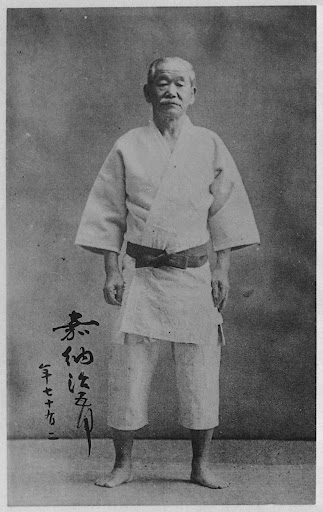
The success was immediate. Judo spread worldwide, entered the Olympic Games in 1964 in Tokyo, and became one of the most widely practiced combat sports on the planet. In France alone, it remains the #1 martial art by a massive margin — with over 567,000 registered practitioners in 2024-2025 and more than 5,200 clubs across the country.
Mitsuyo Maeda, Kimura, and the bridge to Brazil
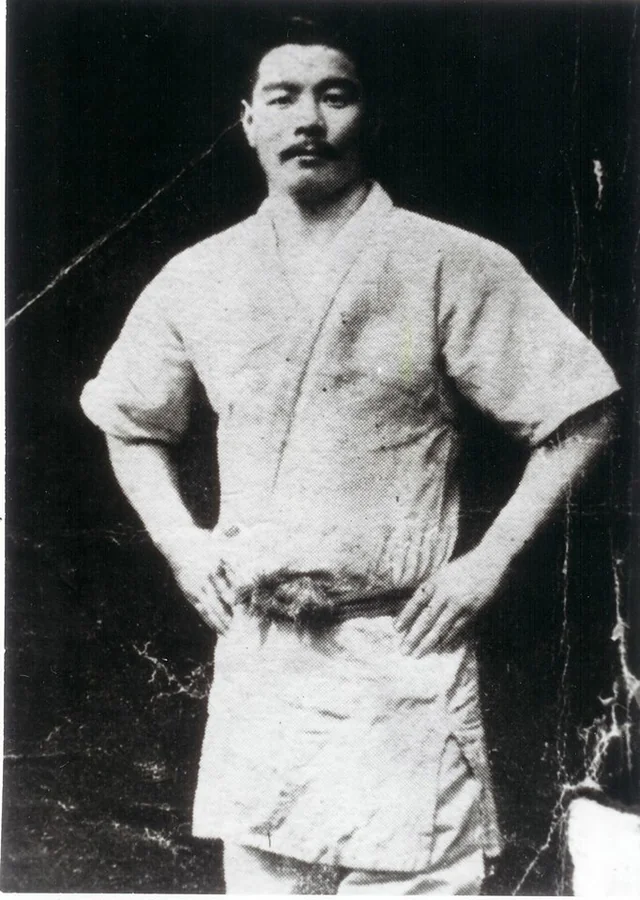
This is where the story gets fascinating. Among the Kodokan students, a man named Mitsuyo Maeda — a high-level judoka and fierce fighter — left Japan on a world tour of fights and demonstrations. In 1914, he arrived in Brazil, first in the south of the country, before settling in Belém, in the north, a few years later. There he crossed paths with the Gracie family. Carlos Gracie, then his brother Hélio, learned Maeda’s “judo” — but it was quite different from what was being practiced at the Kodokan. Maeda emphasized newaza (ground work), submissions, and real fighting. The Gracies took this foundation, adapted it, refined it — and Brazilian Jiu-Jitsu was born.
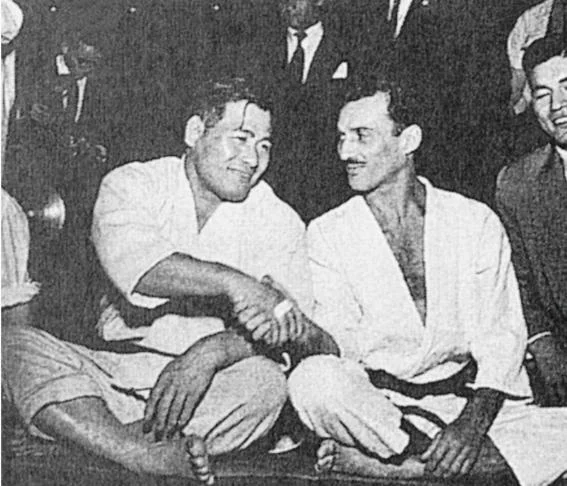
The other figure who sealed the bond between Judo and BJJ is Masahiko Kimura. In 1951, the legendary Japanese judoka — widely considered the greatest judoka of all time — faced Hélio Gracie in Rio de Janeiro. Kimura won by ude-garami (a shoulder lock), a technique that would forever bear his name in BJJ vocabulary: the “kimura.” It was a defining moment. It proved both the devastating power of Judo standing up and the resilience of BJJ on the ground — Hélio, significantly lighter, held on far longer than anyone expected.
For a deeper dive into this history, we’ve traced the history of BJJ in 10 key dates. And if you’re fascinated by Rickson Gracie — Hélio’s son, the man who carried BJJ to the top — his full profile is here.
BJJ vs Judo Rules: Two Sports, Two Logics
This is probably the most visible difference between BJJ and Judo — and it shapes everything else: technique, strategy, the rhythm of matches.
Judo: victory through the spectacular
In Judo, the ultimate goal is the ippon — a perfect throw that lands the opponent flat on their back with force, speed, and control. An ippon ends the match immediately. That’s the ideal of Judo: one technique, one victory. Clean, decisive, spectacular.
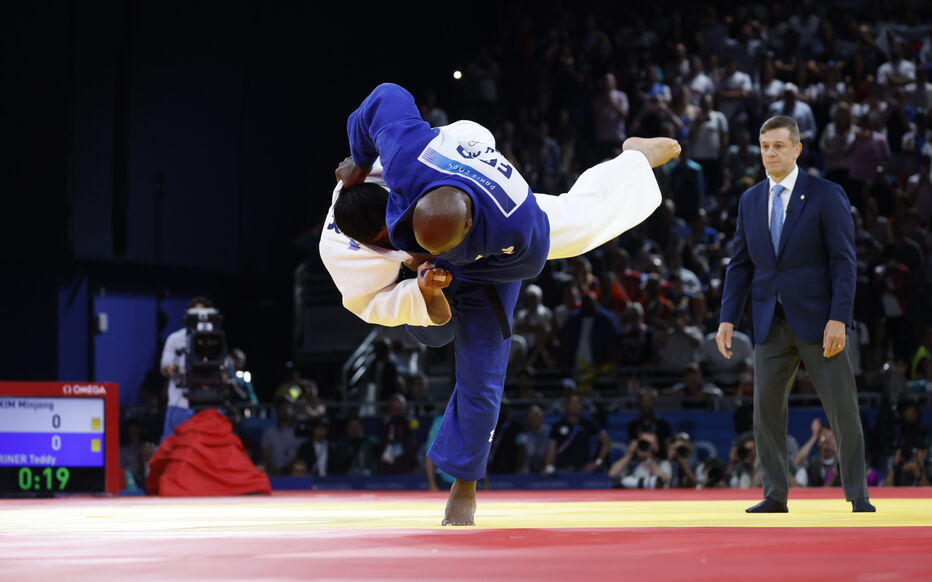
Ground work (newaza) exists in Judo, but it’s governed by strict rules. The referee can stand fighters up if the action on the ground is deemed insufficient, and time spent on the mat is generally limited. Pins (osaekomi) can lead to an ippon if held for 20 seconds. Chokes and armlocks (elbow only) are allowed, but leg locks are completely banned.
Since the 2010s, international Judo rules (IJF) have further reduced the role of ground fighting: leg grabs while standing are banned, passivity is penalized, and fighters are stood back up quickly. The stated goal is to make Judo more spectacular for TV and the Olympics. But this evolution comes at a cost — many judokas feel the sport has become technically poorer by sacrificing newaza.
BJJ: victory through submission
In Brazilian Jiu-Jitsu, the most valued victory is the submission — forcing the opponent to tap out via a choke or joint lock. Unlike Judo, there’s no time limit on the ground. Ground fighting IS the fight. It’s the heart of the sport.
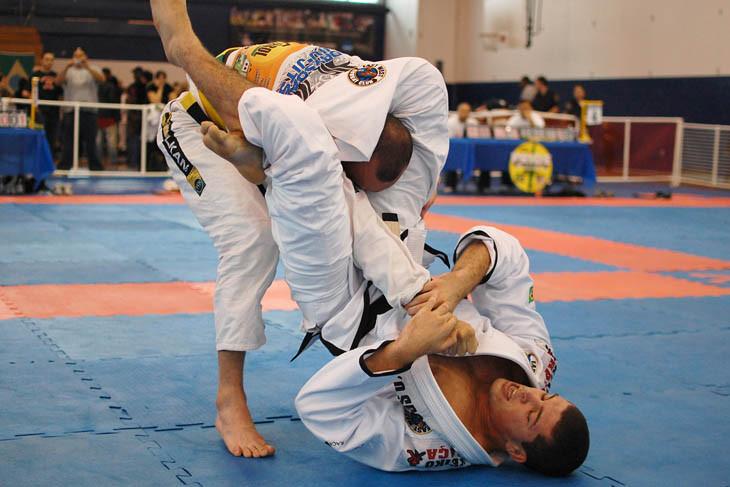
IBJJF rules (the most influential federation in competitive BJJ) award points for dominant positions: takedown (2 points), sweep (2 points), guard pass (3 points), mount (4 points), back take (4 points). But the submission remains the holy grail — it wins at any moment, regardless of the score.
The technical arsenal is far broader than in Judo: armlocks, shoulder locks (the famous kimura), chokes, and — depending on belt level and federation — leg locks, including the devastating heel hook. If you watched UFC BJJ 5, you know what we’re talking about: Jalen Fonacier finished his fight in 19 seconds with an inside heel hook. The kind of technique that simply doesn’t exist in Judo.
Summary
| Criteria | Judo | Brazilian Jiu-Jitsu (BJJ) |
|---|---|---|
| Primary objective | Ippon (perfect throw) | Submission (force opponent to tap) |
| Ground fighting | Limited (referee stands fighters up) | Unlimited (ground IS the fight) |
| Leg locks | Banned | Allowed (depending on belt and federation) |
| Scoring | Ippon, waza-ari, osaekomi | Takedown, sweep, guard pass, mount, back take |
| Leg grabs standing | Banned (since 2010) | Allowed |
| Time on the ground | Short (10-30 seconds max) | Unlimited |
BJJ vs Judo Techniques: Standing or on the Ground
The rules shape the techniques, and this is where the two disciplines diverge the most.
Judo: the art of the throw
Judo is primarily a standing art. Judokas spend thousands of hours perfecting their throws: uchi-mata, seoi-nage, harai-goshi, osoto-gari… Mastering kuzushi (off-balancing) is fundamental. The idea is to feel your opponent’s weight, find the exact moment they’re vulnerable, and throw them with power and precision.
It’s physically demanding. Grip fighting (the battle for grips on the judogi) is an art in itself, and elite judokas develop grip strength and explosiveness that few athletes in other sports can match.
Ground work exists, of course. Judokas learn pins, chokes, and elbow locks. But training time devoted to the ground is generally minimal compared to standing work — some estimate the split at 70/30 or even 80/20 in favor of tachi-waza (standing techniques).
BJJ: the art of ground fighting
In BJJ, the ratio is flipped. The ground occupies the vast majority of training time. You learn to fight from a dizzying variety of positions: closed guard, half guard, De La Riva guard, butterfly guard, X-guard, 50/50… Each position is a world unto itself, with its own attacks, defenses, and transitions.
Standing work isn’t absent — takedowns and guard pulling are part of the game — but it’s less developed than Judo’s standing repertoire. In BJJ competition, it’s common to see a fighter deliberately pull guard to bring the fight to the mat. In Judo, that would be unthinkable and penalized.
BJJ is also the most fertile ground for technical innovation in all of martial arts. Entire leg lock systems have been developed over the past twenty years (popularized by coaches like John Danaher and his students), and positions like the berimbolo or the worm guard didn’t exist fifteen years ago. The sport evolves at a pace that Judo — more institutional, more regulated — simply doesn’t.
BJJ vs Judo Uniform: Gi, Kimono, and No-Gi
Judo is practiced exclusively in a judogi — a thick jacket, pants, and a colored belt. The judogi is built to withstand the violent pulling and gripping of throws. Competition colors are limited to white and blue.
BJJ offers two options. In gi, the fighter wears a BJJ gi — similar to a judogi but with a slimmer cut, often available in a wide range of colors. The gi adds a tactical dimension to the fight: you can grip the collar, sleeves, and lapels to control, choke, and submit. In no-gi, you fight in a rashguard and shorts — no fabric grips possible. The game changes dramatically: more speed, more scrambles, and leg locks become even more important.
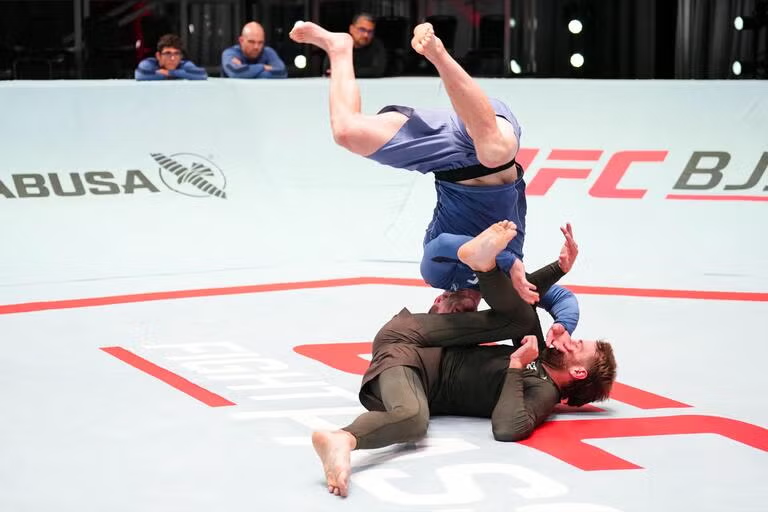
No-gi has become a discipline in its own right, with its own competitions (ADCC, UFC BJJ) and its own stars. It’s one of the most passionate debates within the BJJ community — gi purists vs no-gi addicts — and one we’ll be breaking down in a dedicated article soon.
Philosophy and Culture: BJJ vs Judo, Two Different Worlds
Judo: tradition, hierarchy, and the Olympics
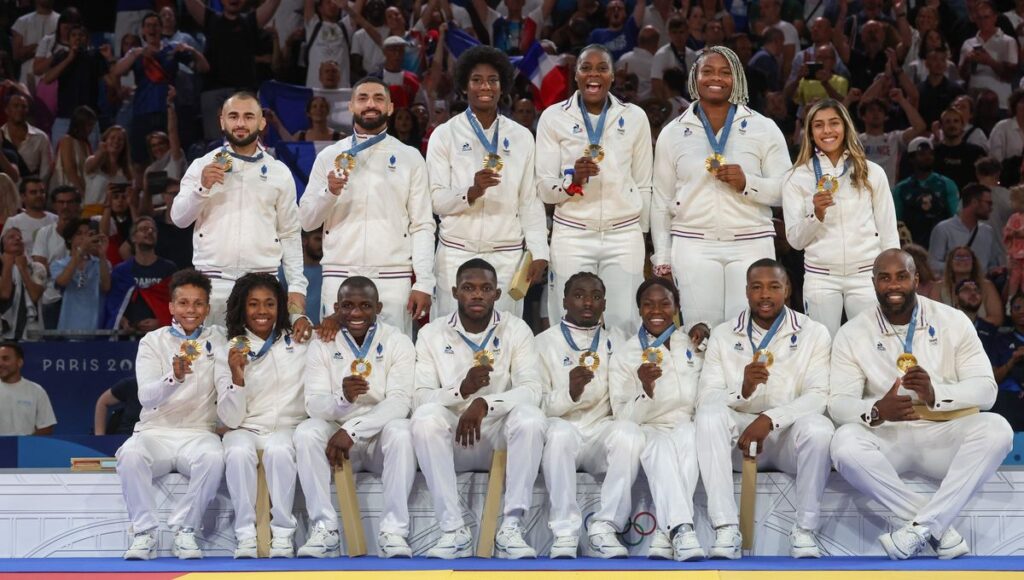
Judo has been an Olympic sport since 1964. That means a powerful international federation (IJF), standardized rules worldwide, a highly structured competition system from the local club to the Olympics, and a culture deeply rooted in Japanese tradition: the bow, respect for the sensei, the discipline of the dojo.
In France — where BJJ-Rules is based — Judo is an institution. Over 567,000 registered practitioners in 2024-2025 (a record over the last decade), more than 5,200 clubs nationwide, decades of Olympic medals (Teddy Riner, David Douillet, etc.), and a positive image among parents. It’s often the first combat sport suggested for children — and for good reasons: Judo teaches discipline, respect, how to fall safely (which is fundamental), and provides a structured environment.
BJJ: community, innovation, and accessibility

BJJ isn’t in the Olympics (not yet?). Its structure is more decentralized, more organic. Academies often function as communities — people talk about their “team” or their “family.” The atmosphere is generally more laid-back than in a traditional Judo dojo, even though respect for the coach and training partners remains essential.
The belt system is slower in BJJ — it takes an average of 10 to 15 years to reach black belt, compared to 3 to 5 years in Judo for a dedicated practitioner. This reflects a different philosophy: in BJJ, each belt represents a significant technical leap and a real test on the mats.
An interesting and relatively new phenomenon: more and more families are enrolling their children directly in BJJ rather than Judo. Just five years ago, this was virtually unheard of in France — Judo was the default, and BJJ was a niche sport for adults. Today, the landscape is shifting. BJJ academies are multiplying, kids’ programs are becoming more structured, and parents are choosing BJJ from the start. It’s a sign that the sport has matured and is no longer reserved for insiders.
To understand why BJJ is booming in France, we analyzed the underlying reasons in this article.
Competition: From the Dojo to UFC BJJ
The Judo circuit
Judo has an extremely structured competitive circuit: regional championships, nationals, Grand Slams, Grand Prix events, World Championships, and the ultimate prize — the Olympic Games. France is historically one of the best nations in the world (second all-time in Olympic Judo medals). The path is clear, structured, and institutional.
The BJJ circuit
In BJJ, the competitive landscape is more fragmented but also more dynamic. The most influential federation is the IBJJF, which organizes the Pan-Americans, Europeans, and World Championships. The ADCC (Abu Dhabi Combat Club) is considered the most prestigious no-gi tournament. And since 2025, UFC BJJ has added a spectacular dimension with an MMA-inspired format: individual bouts, champion titles, top-tier production — all free on YouTube.
In France, the CFJJB organizes national championships and manages the French national team, which is growing stronger every year. The institutional landscape, however, remains complex: an ongoing power struggle pits the CFJJB against France Judo over who controls Brazilian Jiu-Jitsu in the country — a conflict we’ve broken down in detail here. The Nova GP 2026, the CFJJB’s first premium event, showed a new level of ambition for French BJJ.
BJJ vs Judo for Self-Defense: Who Wins in the Street?
We’re not going to dodge this question, because everyone asks it. And the honest answer is: it depends.
Judo provides a massive advantage in standing self-defense. An experienced judoka can throw an attacker to the ground in a split second — and on concrete, a throw can end an altercation immediately. The ability to stay on your feet, manage distance, and use an aggressor’s momentum against them is a serious asset.
BJJ excels in managing the fight on the ground. If the altercation goes to the floor — and it often does — a BJJ practitioner will know how to control the situation, neutralize a bigger and stronger opponent through chokes or joint locks. This is exactly what the early UFCs proved, where Royce Gracie, significantly lighter than his opponents, submitted them systematically on the ground.
In reality, the ideal would be to master both. And that’s exactly what many MMA fighters do: Judo for the clinch and throws, BJJ for control and finishes on the ground. But if we had to pick just one martial art for self-defense, BJJ holds a slight edge: its ability to neutralize an attacker without necessarily causing severe injury (a controlled choke is legally and morally safer than slamming someone on asphalt) is a unique advantage.
BJJ vs Judo: Which Martial Art Should You Choose?
We’re a BJJ media outlet, so we won’t pretend to be perfectly objective. But here’s our honest take.
Judo is an excellent choice if you’re looking for a structured Olympic sport, if you want your child to learn discipline and the art of falling in a traditional setting, if you’re drawn to spectacular throws, or if you want a clear institutional competitive pathway. The quality of coaching, particularly in countries like France and Japan, is historically outstanding.
BJJ is an excellent choice if you’re fascinated by ground fighting and technical problem-solving, if you want a strong community and a relaxed atmosphere, if self-defense is a key motivation, or if you’re drawn to the modern grappling world (ADCC, UFC BJJ). BJJ is also particularly well-suited for smaller body types — the sport’s entire philosophy rests on the idea that technique can overcome brute strength.
The best advice we can give? Try both. Most academies offer free trial classes. Test a Judo class, test a BJJ class — and see where you feel at home. If you’re looking for how to choose your first BJJ academy, we have a complete guide. And if you’re a complete beginner, our guide to starting BJJ covers everything you need to know before your first class.
From Judo to BJJ: A Natural Transition
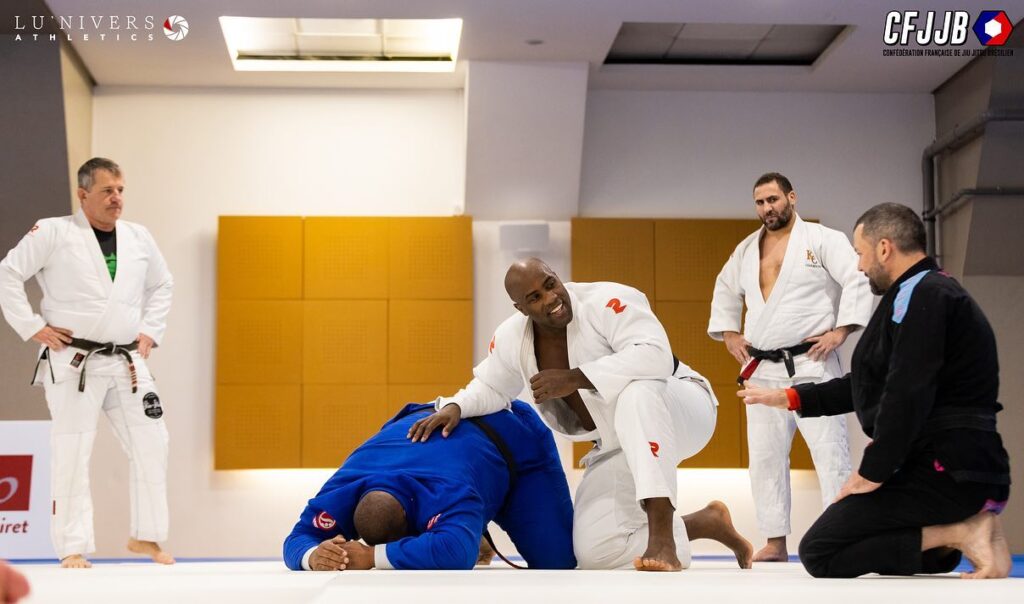
Something that doesn’t get said enough: Judo and BJJ aren’t opposites — they’re complementary. And the transition from one to the other is a natural one.
Many top-level BJJ competitors have a Judo background. Roger Gracie, widely considered the greatest BJJ competitor of all time, had a formidable takedown game inherited from Judo. Champions like Flavio Canto, Travis Stevens, and Ronda Rousey have excelled in both disciplines.
Conversely, French judokas are beginning to incorporate BJJ into their training — and the new generation of French BJJ competitors includes former judokas who found in BJJ a much wider playground on the ground.
If you already train Judo and the ground fascinates you, BJJ opens up an entire universe of techniques that your Judo training doesn’t cover. And your Judo will be a massive advantage in BJJ — especially standing, where most BJJ practitioners are… let’s say, less comfortable.
BJJ vs Judo: Myths vs Reality
The BJJ vs Judo debate carries its fair share of misconceptions. Let’s set the record straight.
“BJJ doesn’t train standup”
Reality: Less and less true. Top-level BJJ competitors have developed solid standing games — takedowns, single legs, body locks. Athletes like Tainan Dalpra or Jonnatas Gracie have takedown skills that would earn respect in any Judo dojo. That said, the average standing level in BJJ remains below Judo’s — that’s a fact. But the gap is closing every year.
“Judo doesn’t do ground work”
Reality: Wrong. Newaza is an integral part of Judo — chokes, pins, and elbow locks are taught in every dojo in the world. What IS true is that competition rules limit time on the ground: the referee stands fighters up quickly when the action stalls. As a result, judokas devote less training time to ground work than BJJ practitioners. But an experienced Judo player with strong newaza is a formidable opponent for anyone.
“BJJ is too dangerous for kids”
Reality: Kids’ BJJ programs are adapted — no leg locks, no heel hooks, and lots of playful work on positions and movement. The injury rate in kids’ BJJ is comparable to Judo. Both sports teach children how to fall, roll, and respect their training partners. The real question isn’t the sport — it’s the quality of the instructor.
FAQ — BJJ vs Judo
Is BJJ more effective than Judo for self-defense?
Both are effective but in different phases of a fight. Judo excels standing (throws, distance management), while BJJ excels on the ground (control, submissions). For self-defense, BJJ holds a slight edge because it allows you to neutralize an attacker without necessarily causing severe injury. Ideally, you’d know both.
Can you transition from Judo to BJJ easily?
Yes, and it’s one of the most natural transitions in martial arts. A judoka starting BJJ will have a huge advantage standing (takedowns, grip management) and will mainly need to develop their guard game and leg lock attacks. Many BJJ champions have a Judo background — it’s one of the best possible foundations.
Which should I choose for my child: Judo or BJJ?
Both are excellent choices. Judo offers a more structured and institutional framework, with a clearly defined competitive pathway. BJJ tends to have a more relaxed atmosphere and emphasizes problem-solving on the ground. The best approach is to try a class in each and see where your child feels most comfortable. Either way, they’ll learn discipline, respect, and self-confidence.
Will BJJ become an Olympic sport?
That’s the big question. For now, BJJ isn’t on the Olympic program. Several obstacles remain: the fragmentation of federations, the lack of standardized rules worldwide, and competition with Judo (already Olympic) within the grappling family. But BJJ’s explosive growth, the arrival of UFC BJJ, and the progressive structuring of national federations (like the CFJJB in France) suggest this question will become a serious conversation in the years ahead.
Conclusion — Two Arts, One Respect
One grew up within the institutional framework of the Olympics and Japanese tradition. The other was forged in the academies of Brazil, then the world, carried by technical innovation and community spirit.
Both are extraordinary martial arts. Both demand discipline, perseverance, and humility and both will teach you things about yourself that very few other activities can.
But if we had to sum up the fundamental difference in one sentence: Judo teaches you how to put someone on the ground. BJJ teaches you what to do once you’re there.
And we’re a BJJ media. So here’s our advice: come to the ground. That’s where the real chess match begins.
Follow all BJJ news on BJJ-Rules — France’s #1 Brazilian Jiu-Jitsu media.